
Guide
16 kW heat pump: which houses need one and when it must be three-phase
A 16 kW pump is for houses that need 13.4–17.8 kW: 250–300 m² well insulated, 200 m² with average insulation, or a small guesthouse. The three-phase version does not use less, it spreads the current over three phases.
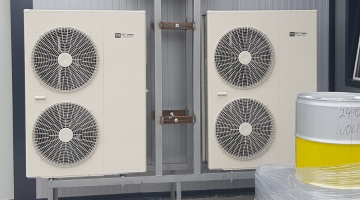
A 16 kW heat pump fits a house whose heat demand lands between about 13.4 and 17.8 kW: usually 250–300 m² that are well insulated, 200 m² with average insulation, a large single-storey house or a small guesthouse. The three-phase version does not use less electricity. You choose it because it spreads the current over three phases, and above 11 kVA per supply point the grid operator normally asks for a three-phase connection.
Which houses need a 16 kW heat pump
You size a heat pump by the heat demand of the house, not by its floor area. On the sizing page we use the same formula explained in detail in the article on how to size a heat pump:
kW = floor area × W/m² ÷ 1000 × (ceiling height ÷ 2.6 m) × storey factor + people × 0.2 kW
The starting values are 55 W/m² for a well insulated house, 75 W/m² for average insulation and 100 W/m² for a poorly insulated one. A single-storey house gets 10% added, one with ground floor, first floor and attic 5% taken off. The sizing tool accepts a pump up to 10% below the demand, because the coldest design day only comes a few times a winter. In practice, the 12 kW model covers up to 13.3 kW and the 16 kW model takes over from there up to about 17.8 kW. That band is where it belongs.
Heat pump for 250 and 300 m²: the numbers
The examples below use the sizing tool's default values, a 2.6 m ceiling and underfloor heating.
| House | Calculation | Demand | Result |
|---|---|---|---|
| 200 m², average insulation, two storeys, 4 people | 200 × 75 ÷ 1000 + 0.8 | 15.8 kW | 16 kW |
| 150 m², poorly insulated, two storeys, 4 people | 150 × 100 ÷ 1000 + 0.8 | 15.8 kW | 16 kW |
| 220 m², well insulated, single storey, 4 people | 220 × 55 ÷ 1000 × 1.10 + 0.8 | 14.1 kW | 16 kW |
| 250 m², well insulated, two storeys, 4 people | 250 × 55 ÷ 1000 + 0.8 | 14.6 kW | 16 kW |
| 300 m², well insulated, two storeys, 4 people | 300 × 55 ÷ 1000 + 0.8 | 17.3 kW | 16 kW |
| Guesthouse, 280 m², well insulated, three levels, 8 people | 280 × 55 ÷ 1000 × 0.95 + 1.6 | 16.2 kW | 16 kW |
| 250 m², average insulation, two storeys, 4 people | 250 × 75 ÷ 1000 + 0.8 | 19.6 kW | 2 × 10 kW |
In short: for 250 m², 16 kW only if it is well insulated; otherwise it needs more than a single unit can deliver. For 300 m², 16 kW works only for a well insulated house on at least two storeys. The same floor area without insulation needs two or even three units in cascade. For houses of 100–200 m², the full table is in the article on how to size a heat pump.
There is no 14 or 15 kW pump in the range. If your calculation comes out at 14–15 kW, the answer is the 16 kW model, and the extra 1–2 kW are welcome for hot water and for the frosty days.
When 16 kW is too much
If your house needs less than 13 kW, do not buy 16 kW "to be safe". A pump that is far too big reaches the set temperature quickly, stops and starts again a few minutes later. Frequent starts raise consumption and wear the compressor. The sizing tool warns you when the model is more than 1.35 times the demand, which for 16 kW means any house needing less than 11.9 kW.
Single-phase or three-phase: what your grid connection says
The 16 kW pump comes in two versions: Chofu 16 kW single-phase, 230 V, and Chofu 16 kW three-phase, 380 V. They have the same heat output, the same casing and the same refrigerant, R32. What differs is how they draw current from the grid. The full data sheets are on the product pages; here are only the figures that matter for your connection.
| Model | Supply | Rated current | Maximum current | Power input at A7/W35 |
|---|---|---|---|---|
| 16 kW R32 | 230 V, one phase | 16.3 A | 25.3 A | 3.72 kW |
| 16 kW R32 three-phase | 380 V, three phases | 6.0 A per phase | 9.0 A per phase | 3.90 kW |
| 12 kW R290 Standard three-phase | 380 V, three phases | 3.9 A per phase | 8.0 A per phase | 2.57 kW |
| 2 × 8 kW R290 Standard | 230 V, one phase each | 2 × 7.4 A | 2 × 16.6 A | 2 × 1.70 kW |
The single-phase version can draw up to 25.3 A on one phase, almost 5.8 kVA, on top of everything else in the house: hob, oven, electric water heater, washing machine. The three-phase version draws at most 9 A on each phase. The total power is almost the same, but it is split three ways.
When you need a three-phase connection
The Romanian regulator's rules on connection solutions say that a single-phase connection is normally used for loads of up to 11 kVA (ANRE Order no. 102/2015, art. 7). Above that, the distribution operator gives you a three-phase solution. The power approved for your property is written in the technical connection approval (aviz tehnic de racordare) or in the connection certificate.
In practice, three situations come up often:
- You already have a three-phase connection. Choose the three-phase version: the electrician connects it directly and the phases stay balanced.
- You have a single-phase connection with enough approved power. The 230 V version works, on its own circuit with protection sized by the electrician from the maximum current in the data sheet.
- You have a single-phase connection and the approved power is not enough once the pump is added to the rest of the house. You apply to the distribution operator for a power increase. If the new power goes beyond what one phase allows, the increase also means switching to three-phase. Start the application before you order the pump, because it takes time.
A guesthouse or a small business often already has a three-phase connection, for the kitchen and other equipment. There the three-phase version is the natural choice.
Does the three-phase version use less electricity?
No. The heat produced is the same, and the house decides how much electricity it takes. On paper, the three-phase version is even slightly less efficient: COP 4.10 against 4.30 at +7 °C outside and 35 °C flow, SCOP 4.1 against 4.5 at 35 °C. At 55 °C both have a SCOP of 3.2. You choose three-phase for the grid connection, not for the bill. The current drawn by each Chofu model, from 6 to 16 kW, and the fuse it needs are in the article on single-phase or three-phase heat pumps.
Power consumption of a 16 kW heat pump
How much a 16 kW heat pump uses depends on the house, not on the label on the unit. We use the same assumptions as in the article what a winter with a heat pump costs: climate zone II (−15 °C, Oradea, Arad, Bucharest), 1,980 full-load hours a year, space heating only, electricity at 1.35 lei/kWh. A house that needs 15 kW needs 15 × 1,980 = 29,700 kWh of heat a year.
| Option | SCOP from data sheet | Electricity per year | Cost at 1.35 lei/kWh |
|---|---|---|---|
| 16 kW single-phase, underfloor | 4.5 | 6,600 kWh | 8,910 lei |
| 16 kW three-phase, underfloor | 4.1 | 7,244 kWh | 9,779 lei |
| 16 kW, either version, radiators at 55 °C | 3.2 | 9,281 kWh | 12,530 lei |
| 2 × 8 kW R290 in cascade, radiators at 55 °C | 3.5 | 8,486 kWh | 11,456 lei |
These figures are an upper limit: the method does not subtract sunshine through the windows or the heat from people and appliances, so the actual bill usually comes out lower. With an electricity offer of 1.11 lei/kWh, the underfloor option drops to about 7,300 lei a year. At full output, at +7 °C outside, the single-phase model draws 3.72 kW from the grid.
The gap between underfloor and radiators is bigger than the gap between the versions. If you have the choice, underfloor heating cuts the bill more than any choice of model.
Two 8 kW units in cascade: the radiator alternative
The R32 models, including both 16 kW ones, heat water up to 60 °C. For underfloor heating that is plenty. For classic radiators sized for a gas boiler, it often is not. The R290 range reaches 75 °C and works with existing radiators, but the largest R290 unit is 12 kW. That is why, for radiators, the sizing tool does not suggest 16 kW but two 8 kW R290 Standard pumps joined with a cascade kit.
A cascade has real advantages. Only one unit runs while the weather is mild, which is most of the winter, and the second one starts only when it gets cold. If one fails, the other keeps heating at half output until the service engineer arrives. And with a three-phase connection, the electrician can put the two units on different phases. On the other side: two units take more space outside, need two bases and longer pipe runs, and installation costs more. On a single-phase supply the two together can reach 33.2 A at peak, so the approved power needs an even closer look.
The kit connects up to five pumps on the same system. For a house, two are almost always enough. For a guesthouse or a larger building, the full calculation is in the article on cascade heat pumps. Beyond what three units cover, we want to see the house plans first. The real differences between the two refrigerants are explained in R290 vs R32.
R32 at 16 kW and the 2027 ban
Both 16 kW models in the range use R32. From 1 January 2027, Regulation (EU) 2024/573 bans placing on the market new monobloc heat pumps that contain fluorinated gases with a GWP of 150 or more, including the 12–50 kW class (EUR-Lex, Annex IV). R32 has a GWP of 675.
What this means for you:
- An installed R32 pump stays legal. It keeps running and can still be repaired, and the circuit of a monobloc pump is sealed at the factory.
- Units placed on the market by the end of 2026 can be sold while stock lasts. After that, in today's range, 16 kW from a single unit no longer exists; the answer becomes an R290 cascade.
- If you have underfloor heating and your figure is 16 kW, R32 is still a good choice, with 3 years' warranty on the unit and 5 years on the compressor, like every model (warranty terms).
Hot water and buffer tank in a large house
In a 250–300 m² house or a guesthouse, hot water needs more thought than space heating. For five or six people we recommend a 300 litre cylinder with a 4 m² coil, made for the lower temperature of a heat pump. Size and coil are covered in the article on which hot water cylinder you need.
Large houses usually have many circuits, with room thermostats that close independently. When several close at once, the pump is left with too little water to heat and starts cycling on and off. A 100 litre buffer tank fixes that. If the plant room is small, the cylinder with integrated buffer puts both in one body.
Do not forget the outdoor unit. The 16 kW models are 1.42 m tall and weigh 116–120 kg, so they need a solid base and free space in front. How to choose the spot so the neighbours are not bothered is in the article on noise and placement.
A real project: a guesthouse with 16 kW three-phase and a 300 l cylinder
At Pensiunea AnaMaria in Băile Felix a 16 kW three-phase unit with a 300 litre cylinder was installed in 2021. The pump heats the whole building and makes hot water for the rooms. The problem with the old system was the morning: all the guests shower in the same two hours, and the hot water could not keep up.
The fix was not a bigger pump. The cylinder charges overnight on the cheaper tariff and covers the morning peak without the pump running flat out. For the rest of the day, 16 kW is exactly right. We recommend the same logic for any large house: size the pump for space heating and cover hot water peaks with storage volume, not with extra kilowatts.
What to choose, in short
| Your situation | What to choose |
|---|---|
| Demand 13.4–17.8 kW, underfloor, single-phase with enough power | 16 kW single-phase |
| Demand 13.4–17.8 kW, underfloor, three-phase connection | 16 kW three-phase |
| Demand 13.4–17.8 kW, radiators | 2 × 8 kW R290 with a cascade kit |
| Demand below 13.3 kW, three-phase connection | 12 kW R290 three-phase or smaller |
| Demand above 17.8 kW | Two or three units in cascade, after a full calculation |
Frequently asked questions
How many square metres does a 16 kW heat pump cover?
About 300 m² if the house is well insulated and on two storeys, or 200 m² with average insulation. What counts is the heat demand, not the area: 16 kW covers houses that need between 13.4 and 17.8 kW.
Can I run a 16 kW pump on a single-phase supply?
Yes, if your approved power is enough. The 230 V model draws up to 25.3 A on one phase. If it is not enough, you apply for a power increase with the distribution operator; above about 11 kVA the usual solution is three-phase.
How much electricity does a 16 kW heat pump use?
For a house that needs 15 kW, in climate zone II, with underfloor heating, around 6,600 kWh a year, or 8,910 lei at 1.35 lei/kWh. On radiators at 55 °C, around 9,300 kWh. At full output, at +7 °C outside, it draws 3.72 kW.
Is the three-phase version better?
It is not more efficient. On paper its SCOP at 35 °C is even slightly lower (4.1 against 4.5). You choose it when you have a three-phase connection, to spread the current across the phases.
Can I still buy a 16 kW R32 pump after 2027?
Only from stock placed on the market by 31 December 2026. R32 pumps already installed stay legal and can still be repaired.
Where can I see the price of the 16 kW pump?
On the product pages, for the single-phase version and the three-phase version. For a price with installation, cylinder and buffer, ask for a quote.
Next step
Put your house's figures into the sizing tool and see whether you really come out at 16 kW, or at a smaller model. For the final figure, tell us what grid connection you have and what heats your rooms, and we will do the full calculation and send you an itemised quote.
Next step
Find the heat pump that fits
Same questions, two minutes, no contact details.
Next steps
If you're clear on the output
Your next step depends on where you've got to: the figure for your house, the models that cover it, or who does the installation.
- Work out your house's heat demand Same questions, two minutes, no contact details.
- See the Chofu models From 4 to 16 kW, with the output and coverage for each.
- Who does the installation Certified Chofu partner installers, vetted by NEDAVI. You choose who does the job.