
Guide
Cascade heat pumps for guesthouses, restaurants and larger buildings
For a guesthouse, a restaurant or a large house, two or three units in cascade run at a sensible output more often and do not leave you in the cold if one stops. See which cascade you get for 20, 30 or 40 kW.
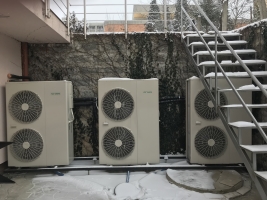
Cascade heat pumps are two, three or more units connected to the same system, switching on one after another as the building needs more heat. For a guesthouse, a restaurant, an office or a house that needs more than 16–18 kW, they are usually a better choice than one big heat pump: they run at a sensible output more of the time, and if one stops, the others keep heating.
What cascade heat pumps are
In a cascade, each outdoor unit is a complete heat pump with its own compressor and controls. A cascade kit links them and decides how many run. The kit we sell connects up to five Chofu heat pumps to one system. The configurator on this site looks for a cascade of up to three identical units by itself when no single model covers the building. Above three units, we want to see the floor plan first.
The units are identical because that way the running hours are shared evenly, the spare parts are the same, and the controls treat them as equal steps of output.
Why several small units beat one big heat pump
A building rarely needs full output
Output is sized for the coldest day of the winter, and there are few of those. For climate zone II (−15 °C: Oradea, Arad, Bucharest) the configurator counts 1,980 equivalent full-load hours a year, while a heating season has several times as many hours. For most of the winter, the building asks for a fraction of its design output.
An inverter heat pump can slow its compressor down, but only to a point. Below that, it starts, reaches the set temperature, stops and restarts a few minutes later. A big unit on a small load ends up doing this all the time. In a cascade of three, one unit alone runs at night or in autumn, close to a comfortable output, and the second and third only join in when it gets cold.
If one unit fails, you are not left in the cold
With one heat pump, a fault in January means no heating until the part arrives. With three, you lose a third of the output and the other two keep the rooms warm while the repair is done. For a guesthouse with guests staying, this matters more than any efficiency figure.
Servicing without switching the heating off
An annual service is required for the warranty on any heat pump. In a cascade with valves on each unit, the technician isolates one unit and works on it while the rest of the system keeps running. Each unit carries the same warranty: 3 years on the unit and 5 years on the compressor.
What you pay for it
Two or three units take up more space outside and need separate bases, longer pipe runs and the cascade controls. Installation costs more than for a single unit. For a well-insulated 250 m² house, one 16 kW heat pump is usually the simpler answer; everything beyond one unit is covered below.
A 20, 24, 30 or 40 kW heat pump: which cascade you get
If you are looking for a 24, 30 or 40 kW air-to-water heat pump, you will rarely find a single residential unit that size. The largest Chofu unit is 16 kW, on R32. On R290, the largest is 12 kW. The configurator accepts a total output up to 10% below the heat demand, because the coldest day only comes a few times a winter, and picks the smallest number of identical units that is enough. For radiators, only the R290 models remain, since they raise the flow temperature to 75 °C.
| Heat demand | Underfloor heating | Radiators (R290, up to 75 °C) |
|---|---|---|
| up to 17.8 kW | one unit, 16 kW at most | one unit, 12 kW at most (up to 13.3 kW) |
| 18–20 kW | 2 × 10 kW | 2 × 10 kW |
| 24 kW | 2 × 12 kW | 2 × 12 kW |
| 30 kW | 2 × 16 kW | 3 × 10 kW |
| 36–40 kW | 3 × 12 kW | 3 × 12 kW |
| 48 kW | 3 × 16 kW | more than three units, with a plan |
| above 53 kW | more than three units, with a plan | more than three units, with a plan |
In short, three units cover up to about 53 kW with underfloor heating and up to about 40 kW with radiators. The figures in the table are the calculated heat demand, not the floor area. How to get there for your building, step by step, is shown in the example below and on the sizing page.
What about a 100 kW heat pump?
With the Chofu range you cannot get there from one kit. Five 16 kW units give 80 kW nominal, five 12 kW R290 units give 60 kW. A building that needs 100 kW needs a building services design by an engineer, and the first thing to check is whether the demand really is that high. In older buildings, insulation often cuts the figure more than any choice of equipment.
Example: a 400 m² guesthouse with 8 rooms
We use the configurator's formula and default values, the same as in the article on the 16 kW heat pump:
kW = floor area × W/m² ÷ 1000 × (ceiling height ÷ 2.6 m) × storey factor + occupants × 0.2 kW
The guesthouse has 400 m² over a ground floor and one upper floor, 2.6 m ceilings, medium insulation (75 W/m²) and 8 double rooms, so 16 people when full. Heating needs 400 × 75 ÷ 1000 = 30 kW. Hot water adds 16 × 0.2 = 3.2 kW. Total demand: 33.2 kW.
| System | Cascade | SCOP from the data sheet | Electricity per year, heating only | Cost at 1.35 lei/kWh |
|---|---|---|---|---|
| Underfloor heating, three-phase supply | 2 × 16 kW three-phase = 32 kW | 4.1 at 35 °C | 14,488 kWh | 19,559 lei |
| Radiators at 55 °C | 3 × 10 kW R290 Premium = 30 kW | 3.61 at 55 °C | 16,454 kWh | 22,213 lei |
With underfloor heating, 32 kW covers 33.2 kW because it is above 90% of the demand. With radiators, two 12 kW R290 units are not enough, so the configurator moves to three units and picks the smallest that will do: 10 kW. The annual cost starts from 30 kW × 1,980 hours = 59,400 kWh of heat, divided by the SCOP, as in the article on what a winter costs. It is an upper limit: the method does not subtract sunshine through the windows or the heat people give off, and a guesthouse is rarely full all winter.
On a November night with three rooms taken, the building may need a third of its output. With radiators, a single 10 kW unit handles that alone. One 30 kW heat pump, if it existed, would be switching on and off all night.
Hot water in a guesthouse
In a guesthouse, hot water is the hard part, not heating. Guests shower in the same two hours in the morning. The rule used in the article on which hot water cylinder you need starts from 50 litres per person, stored at 60 °C. For 16 guests that would be 800 litres. The rule was made for homes, and in a guesthouse the number of bathrooms and whether there are bathtubs matter just as much, so we set the final volume on site.
The cylinders we supply hold 200 and 300 litres, with a coil enlarged for a heat pump (3 and 4 m²). A large guesthouse gets several cylinders or a bigger tank; the same manufacturer's data sheet also lists 500, 800 and 1,000 litre versions. The cylinder charges overnight, and the stored volume covers the morning peak, not extra kilowatts.
That is what we did at Pensiunea AnaMaria in Băile Felix in 2021: a single three-phase 16 kW unit with a 300 litre cylinder. The cylinder charges at night, on the cheaper tariff, and covers the morning showers without the heat pump running flat out. No cascade was needed there, because the heating fitted within 16 kW. The single-unit case is covered in detail in the article on the three-phase 16 kW heat pump.
A guesthouse with a swimming pool
The Chofu installation manual forbids connecting the heat pump directly to pool water, process water or domestic water. For a pool, an intermediate heat exchanger goes between the heat pump circuit and the pool water. The exchanger and the output the pool needs go into the calculation from the start, not after installation.
Buffer tank and hydraulic layout of a cascade
The units work in parallel: each sends hot water to the same header or buffer tank, and the building's circuits leave from there. The buffer decouples the heat pumps from the system. When several room thermostats close at once, the units still have a volume of water to heat steadily. The R290 installation manual requires at least 30 litres of water in the system and an additional buffer tank when the system holds more than 160 litres. The Chofu controller can switch the compressor on and off based on a temperature probe fitted in the buffer tank.
What we look at in a cascade, without going into the full diagram, which is drawn for each building:
- Each unit has its own valves, filter and flexible connectors, so it can be isolated for servicing without draining the system.
- The buffer is sized for the whole cascade, not for one unit. For a house with a single heat pump a 100 litre buffer tank is often enough; with three units the volume is calculated.
- The hot water cylinder can be charged by one unit through the three-way valve while the others keep up the heating.
- On old radiators, the flow temperature decides whether R32 will do or you need R290. The details are in the article on old radiators.
It is worth asking the installer whether the controls rotate which unit starts first. Otherwise the first unit clocks up far more hours than the last.
Power supply, space and noise for three units
Guesthouses, restaurants and offices usually have a three-phase supply. There you choose either three-phase units or single-phase units, each on a different phase. From the data sheets: a three-phase 16 kW unit draws at most 9 A per phase, so two of them mean 18 A per phase. Three single-phase 10 kW R290 units, one per phase, draw at most 24 A each. What this means for your approved capacity is explained in the article on single or three-phase.
The units in the examples above (16 kW, 12 kW and R290 Premium 10 kW) are 1.42 m tall and weigh between 98 and 127 kg, so each needs a solid base and clear space in front and behind. Three identical noise sources side by side sound, from the same distance, about 5 dB louder than one, so placement matters more than at a house. The distance rules are in the article on noise and placement.
Hanul Pescarilor: three units, 48 kW, restaurant kept open
At Hanul Pescarilor in Oradea, in 2022 heat pumps replaced two gas boilers that heated the kitchen, the dining room and the guest rooms. The load varied enormously between a busy lunchtime and a winter night with the place empty, and the boilers ran at the same output regardless.
A single unit big enough for the peak would have idled almost all the rest of the time, starting and stopping often. Three units went in, in cascade, 48 kW in total, on the north side of the building. They start one after another as needed: one alone covers the night, all three take the lunchtime peak. The plant room was small and the restaurant could not close for more than a day, so the work was done in stages and it stayed open.
R32, R290 and 2027 for cascades
From 1 January 2027, Regulation (EU) 2024/573 bans placing on the market new monobloc heat pumps with fluorinated gases of GWP 150 or more, including in the 12–50 kW class (EUR-Lex, Annex IV, checked on 27.09.2026). All Chofu R32 models fall under this, including the 16 kW ones.
- An installed R32 cascade stays legal and can still be repaired and serviced.
- R32 units placed on the market before the end of 2026 can be sold while stock lasts.
- After that, new cascades are built from R290 units of up to 12 kW each. Three units give 36 kW, five give 60 kW. The differences between the two refrigerants are in the article R290 or R32.
Frequently asked questions
What are cascade heat pumps?
Two or more identical heat pumps connected to the same system through a cascade kit. They start one after another as the building needs, and their output adds up.
From what output is a cascade worth it?
From about 18 kW of demand, beyond what a single 16 kW unit covers. With radiators, where only the R290 models remain, from about 13.4 kW.
How many heat pumps can be connected in cascade?
The cascade kit connects up to five Chofu heat pumps. The configurator suggests up to three by itself; above three, we do the calculation from the building's plans.
What happens if one unit in the cascade breaks down?
The others keep heating with their own output. With three units you lose a third of the output until the repair, not all of the heating.
Do I need a buffer tank with a cascade?
Almost always, yes. The buffer collects the water from all the units and protects them from frequent starts when thermostats close. The volume is calculated for the whole cascade.
Where can I see the price?
Each model's price is on its product page, and the cascade kit is priced on request. For a cascade with cylinder, buffer and installation, ask for a quote: we itemise it after a site visit.
The next step
Enter the building's details in the configurator and see how many units you get. For a guesthouse, restaurant or office, send us the plan, the number of rooms and the grid connection you have, and we will do the full calculation and the cascade layout.
Next step
Find the heat pump that fits
Same questions, two minutes, no contact details.
Next steps
If you're clear on the output
Your next step depends on where you've got to: the figure for your house, the models that cover it, or who does the installation.
- Work out your house's heat demand Same questions, two minutes, no contact details.
- See the Chofu models From 4 to 16 kW, with the output and coverage for each.
- Who does the installation Certified Chofu partner installers, vetted by NEDAVI. You choose who does the job.