
Guide
How loud a heat pump is and where to install it
Chofu heat pumps have a sound power of 54–64 dB(A). At 5 metres from a unit against a wall you get roughly 35–45 dB(A), and the spot you choose matters almost as much as the model.
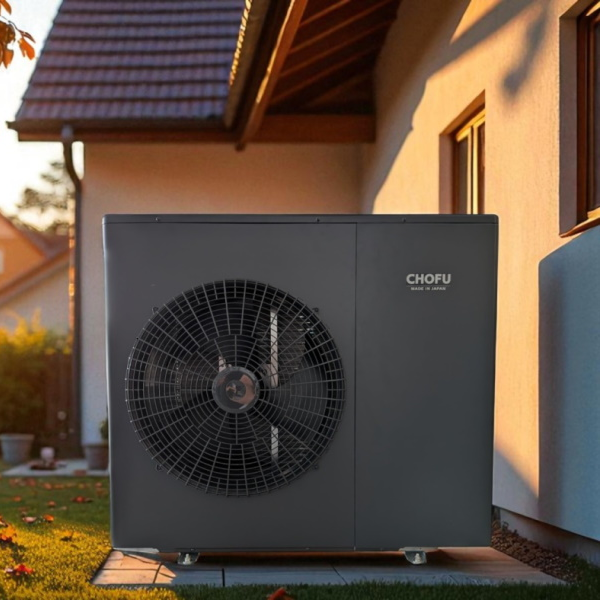
Chofu heat pumps have a sound power of 54 to 64 dB(A), depending on the model. That figure describes the unit, not what you hear: 5 metres from a unit standing against a wall, the calculation gives roughly 35 to 45 dB(A). Below you will find the figures for each model, how to turn them into the noise level at your window or your neighbour's, and the rules we use to choose where the outdoor unit goes.
How many dB is a heat pump: sound power and sound pressure
Data sheets carry two figures that are often mixed up, even in installers' quotes.
Sound power (LW) is the total noise the unit gives off in every direction. It does not depend on distance and you cannot read it directly off a sound meter: it is calculated from several measurements taken around the unit. That is why it is the only figure you can use to compare two heat pumps fairly. It is also the one on the energy label and in the EU's EPREL database.
Sound pressure (Lp) is what you measure at a given point, at a given distance. It is what matters to you and your neighbour, but without the distance it was measured at, it tells you nothing. The difference is explained in detail in the acoustics guide of the German Heat Pump Association (BWP, 2019), which is also where the calculation method below comes from.
Two rules help when reading the numbers. A second, equally loud source adds 3 dB. For the ear to hear a sound as twice as loud, the level has to rise by about 10 dB. So 57 versus 54 dB(A) is not "twice as loud", but you will notice it.
Chofu heat pump noise, model by model
The sound power values are the ones on our product pages, taken from EPREL and the Chofu data sheets. For the R32 models the Chofu sheet also gives a sound pressure, but it does not say at what distance it was measured, so we do not use it. The columns on the right are our own calculation for a unit standing against a wall, using the BWP method: Lp = LW + 6 dB (wall reflection) − 20·log(distance) − 11 dB.
| Model | Sound power | At 3 m | At 5 m | At 10 m |
|---|---|---|---|---|
| R290 Premium 4, 6 and 10 kW | 54 dB(A) | 39.5 dB(A) | 35 dB(A) | 29 dB(A) |
| R290 Standard 6 kW | 56 dB(A) | 41.5 dB(A) | 37 dB(A) | 31 dB(A) |
| R290 Standard 8 kW | 57 dB(A) | 42.5 dB(A) | 38 dB(A) | 32 dB(A) |
| R290 Standard 12 kW | 59 dB(A) | 44.5 dB(A) | 40 dB(A) | 34 dB(A) |
| R32 6 kW | 60 dB(A) | 45.5 dB(A) | 41 dB(A) | 35 dB(A) |
| R32 12 and 16 kW | 62 dB(A) | 47.5 dB(A) | 43 dB(A) | 37 dB(A) |
| R32 10 kW | 64 dB(A) | 49.5 dB(A) | 45 dB(A) | 39 dB(A) |
For the three-phase R290 models (10 kW Premium and 12 kW Standard) there is no published noise figure: they are not registered in EPREL and the data sheet does not give one. We have left them out of the table rather than guess.
The calculation assumes a free field: nothing between the heat pump and where you are listening, and no other wall reflecting the sound. A masonry wall between the unit and the window lowers the level; a narrow yard between two houses raises it. The data sheet value is measured under standard test conditions. On a freezing night, with the compressor running fast, the unit can be louder than the label.
How noise drops with distance
Sound spreads over a larger and larger area as it moves away from the source. In a free field, every doubling of the distance lowers the sound pressure by 6 dB: from 2 to 4 metres you gain 6 dB, from 5 to 10 metres also 6 dB. The first few metres count the most. Moving the heat pump from 3 to 6 metres away from a bedroom window does more than moving it from 10 to 15 metres.
Where the unit stands matters almost as much as distance. The BWP guide adds:
- +3 dB for a free-standing heat pump with no wall closer than 3 m;
- +6 dB for a heat pump against one wall;
- +9 dB for a heat pump in a corner, between two walls or under a low roof overhang.
The corner between the house and the garage looks like the ideal spot, sheltered and out of sight. Acoustically it is the worst: the same heat pump sounds 3 dB louder than against a flat wall, as if you had two of them.
Heat pumps and neighbours: what Romanian rules say
Romania has no rule written specifically for heat pumps, with a minimum distance from the fence. It does have noise limits for the outside of homes, in the hygiene standards approved by Ministry of Health Order no. 119/2014, with Article 16 amended by Order no. 994/2018: outside a home, the equivalent sound pressure level must not exceed 55 dB(A) during the day and 45 dB(A) at night, between 11 pm and 7 am. Where the background noise was already low, the limits drop to 50 and 40 dB(A).
We are not lawyers and cannot tell you how the public health directorate or the town hall applies these values in a dispute between neighbours. We use them as a design threshold: at the neighbour's window, at night, we aim for below 40 dB(A), not "just under 45". If your town hall has local planning rules for equipment in gardens, or you live in an estate with its own rules, ask before installation.
The table shows that an R290 Premium against your wall drops below 40 dB(A) from about 3 metres. An R32 10 kW in the same position needs around 10 metres. On a narrow plot, with the neighbour's window 4 metres away, that difference decides the model.
Quiet night mode
Chofu units have a quiet night mode: during the hours you set on the controller, the unit runs at reduced speed. The fan motor is a variable-speed DC motor that slows down at night; it does not start and stop abruptly but ramps up and down.
Chofu does not publish how much quieter night mode is, so we do not use it in our calculations. We treat it as a reserve, not as the main argument. Reduced speed also means reduced output. In a house sized right at the limit, on the coldest night, the heat pump may need its full output exactly then. One more reason not to pick a model that is too small, which we explain in the article on how to size a heat pump.
Where to install a heat pump
Chofu heat pumps are monobloc: the whole refrigerant circuit sits in the outdoor unit, and only water pipes go into the house. So the question "where do I put it" is about the outdoor unit. The rules we follow during the site visit:
- Not under a bedroom window, yours or your neighbour's. And not with the fan facing it: the sound is stronger in the direction the air is blown.
- Not in corners or between two close walls, not under a low overhang or in a recess. Besides the +9 dB, the cold air blown out comes back into the intake and lowers efficiency.
- Free space around the unit on every side where air goes in or out. The exact clearances from the wall and in front of the fan are in each model's installation manual, and the installer follows them as written.
- On the side of the house facing your own garden, not your neighbour's fence, if you have the choice. The house itself then screens the heat pump from the neighbour.
- Close to the plant room, but not at any cost: more on that at the end.
Wall or ground
Our models weigh between 50 kg (R32 6 kW) and 127 kg (the three-phase R290 models). On the ground, on a concrete slab or kerb-stone footing, the unit is stable, easy to service and does not pass vibration into the building. On a wall bracket, the compressor's vibration travels into the masonry and can be heard in the room behind the wall, especially at night when everything is quiet. The BWP guide says the same: wall mounting only according to the manufacturer's instructions and with the right accessories. In practice, for us, a wall bracket is the exception, for cases where there really is no room on the ground.
The unit should not go on a timber deck or a lightweight slab, which can start to vibrate and amplify the noise.
Heat pump stand and anti-vibration mounts
Besides airborne noise there is structure-borne noise: the compressor's vibration passes through the stand, the pipes and the cables into the walls of the house. That is why the unit is fixed on an anti-vibration support, which is part of every installation. The floor stand with anti-vibration dampers is a separate line in the quote, and the hydraulic connection kit included in every heat pump quote has flexible anti-vibration connectors. A rigid pipe running straight from the heat pump into the wall is one of the most common causes of a "hum" inside the house.
Snow and defrost water
In winter, ice forms on the unit's finned coil. The heat pump melts it by itself with its automatic defrost function, and the water runs out underneath. At 2 °C that is no problem. At −10 °C the same water freezes straight away on the paving and turns the path you walk on every morning into an ice rink.
- The unit stands raised on a stand, above the usual snow depth where you live, so the intake is not covered and the water has somewhere to drain.
- Under the heat pump, gravel or a draining bed, not flat concrete.
- Not next to a path, the front door or above steps.
- Not under eaves without a gutter: snow and icicles falling from the roof hit the casing and the fan.
Distance from the house, and the extra pipe
There is no minimum distance between the outdoor unit and the house beyond the clearance in the manual. There is, however, a practical maximum, set by the pipes. The insulated flow and return run between the heat pump and the plant room. Every extra metre means a little heat lost on the way, a circulation pump working harder and more material.
In the sizing tool you also enter the distance between the heat pump and the plant room. Above 15 metres, the result tells you a longer insulated pipe is needed, and in the quote it appears as a separate line, per metre. We do not hide it in the installation price, so you can compare: moving the heat pump 10 metres further from the bedroom may be worth the extra pipe, or it may not.
R290 safety distances
With propane heat pumps, the location also follows a safety rule. Chofu R290 models hold between 0.50 and 1.15 kg of propane, sealed at the factory in the outdoor unit. Propane is heavier than air, so in the unlikely event of a leak it sinks and can collect in low spots. The unit is placed at the distances given in the installation manual from basement windows, drains, manholes and other openings below ground level. We do not quote figures from other manuals here, because they differ from one manufacturer to another. More on propane safety in the article R290 or R32.
In short: our checklist for the site visit
Heat pump away from bedrooms, fan pointing elsewhere, no corners, on the ground, on an anti-vibration stand, with flexible connectors, with room for snow and defrost water. Only then, as close to the plant room as possible.
If you are still choosing a model, an R290 Premium at 54 dB(A) gives you the most freedom in placement. If you need 16 kW, also read the article on the 16 kW three-phase heat pump, and if you have underfloor heating, that is where we explain which model fits.
Frequently asked questions
How loud is a heat pump?
Chofu heat pumps have a sound power of 54 to 64 dB(A). At 5 metres from a unit standing against a wall, the calculation gives roughly 35 to 45 dB(A), depending on the model.
How far from the neighbours can I install a heat pump?
There is no set minimum distance in Romania. There are the limits in Ministry of Health Order 119/2014: 55 dB(A) by day and 45 dB(A) at night outside a home. We calculate the level at the neighbour's window and aim for below 40 dB(A) at night.
What does 54 dB(A) on the data sheet mean?
It is the sound power, the total noise given off by the unit, measured under standard conditions. It is not what you hear at a given distance. For that you calculate the sound pressure, based on distance and the surrounding walls.
Can I mount a heat pump on a wall?
It can be done, following the manufacturer's instructions, but vibration reaches the house more easily, and the larger units weigh over 100 kg. Whenever there is room, it goes on the ground, on an anti-vibration stand.
Does night mode help?
Yes, the unit runs at reduced speed during the hours you set. Chofu does not publish by how many dB, so we do not rely on it when choosing the location.
How far from the house can the heat pump be?
As far as the pipe run allows. Above 15 metres between the heat pump and the plant room, the extra insulated pipe appears in the quote as a separate line, per metre.
Let's find the right spot
Enter your house's details in the sizing tool, including the distance to the plant room, and see which model fits. If your garden is tight or the neighbours are close, tell us in the quote request: we calculate the level at their window before installation.
Next step
Find the heat pump that fits
Same questions, two minutes, no contact details.
Next steps
If you're clear on the output
Your next step depends on where you've got to: the figure for your house, the models that cover it, or who does the installation.
- Work out your house's heat demand Same questions, two minutes, no contact details.
- See the Chofu models From 4 to 16 kW, with the output and coverage for each.
- Who does the installation Certified Chofu partner installers, vetted by NEDAVI. You choose who does the job.