
Guide
8 kW heat pump: the 120–140 m² house and when it is too small
On two storeys, 8 kW means roughly 107–147 m² of well insulated house. The Chofu R290 Standard started at −12 °C in Sălaj without a backup electric heater.
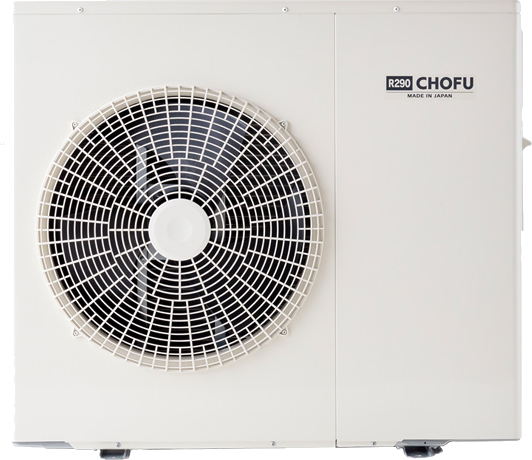
By the formula in our configurator, an 8 kW air-to-water heat pump covers a two-storey house of 107–147 m² if it is well insulated, 79–107 m² with average insulation and 59–80 m² if the insulation is poor. Chofu makes a single 8 kW model, the R290 Standard, single-phase, which heats water to 75 °C and which we keep in stock in Oradea. On its product page we say it covers a house of 110 to 140 m². Below are the sums, the data sheet, a start-up in frost at −12 °C and the signs that you actually need 10 kW.
What size house an 8 kW heat pump is right for
A heat pump is sized on how much heat the house loses on the coldest day, not on floor area alone. On the sizing page we use the same formula we explain in how to size a heat pump:
kW = floor area × W/m² ÷ 1000 × (ceiling height ÷ 2.6 m) × storey factor + people × 0.2 kW
The values are 55 W/m² for a well insulated house, 75 W/m² for average insulation and 100 W/m² for a poorly insulated one. The storey factor is 1.10 for a single-storey house, 1.00 for two storeys and 0.95 with a lived-in attic on top. The configurator allows the pump to be up to 10% below the calculated demand, because the design day only comes a few times a winter. So the 8 kW model covers a demand of up to 8 ÷ 0.9 = 8.89 kW. Below 6 ÷ 0.9 = 6.67 kW, the configurator suggests the 6 kW pump, which covers it too. The oversizing limit is 1.35, so 8 kW would count as "too big" only below 8 ÷ 1.35 = 5.93 kW, and there you are already at 6 kW anyway.
| Insulation | Single storey | Two storeys | Two storeys and attic |
|---|---|---|---|
| Well insulated (55 W/m²) | 97–133 m² | 107–147 m² | 113–154 m² |
| Average insulation (75 W/m²) | 72–98 m² | 79–107 m² | 83–113 m² |
| Poorly insulated (100 W/m²) | 54–73 m² | 59–80 m² | 62–85 m² |
The 120–140 m² house in the title lands on 8 kW only if it is well insulated. For the configurator that means at least 10 cm of insulation on the walls, 15 cm in the loft and triple glazing. With 5 cm on the walls, 8 cm in the loft and double glazing, the same house is rated "average insulation", and at 120 m² it already needs 9 + 0.8 = 9.8 kW, that is 10 kW. We take the 120 m² house apart in detail in our article on the heat pump for a 120 m² house.
Worked example: a 130 m² house on two storeys
Take a 130 m² house on two storeys, 2.6 m ceilings, 10 cm of polystyrene on the walls, 15 cm of wool in the loft and triple glazing. The configurator rates it "well insulated". Four people live there, and the rooms still have the radiators from the old boiler.
- Space heating: 130 × 55 ÷ 1000 = 7.15 kW.
- Hot water: 4 × 0.2 = 0.8 kW. Total demand: 7.95 kW.
- The 6 kW pump covers at most 6.67 kW, so it falls short.
- The 8 kW pump gives 8 ÷ 7.95 = 1.01 times the demand. Practically spot on, and far from the 1.35 limit.
- For this house, the 8 kW model stays the suggested one between 107 and 147 m².
At 140 m² the demand rises to 7.7 + 0.8 = 8.5 kW. The 8 kW pump is 6% below it, within the configurator's 10% tolerance, so it is still suggested. It does mean that on the days at −15 °C it runs at its limit. At 120 m² you get 6.6 + 0.8 = 7.4 kW, and 8 kW has an 8% margin. With radiators, the configurator keeps only the R290 models, which heat water to 75 °C. The answer is the Chofu R290 Standard 8 kW.
The 8 kW air-to-water heat pump at Chofu: the R290 Standard data sheet
Every Chofu heat pump is an air-to-water monobloc: only water comes into the house. At 8 kW there is a single product in the catalogue, the R290 Standard, model code AEYC-0849ZU-CH. The figures below come from the Chofu data sheet and the EU EPREL database.
| Specification | R290 Standard 8 kW |
|---|---|
| Model code | AEYC-0849ZU-CH |
| Refrigerant | R290 (propane), GWP 0.02, 0.85 kg |
| Power supply | 230 V / 50 Hz, single-phase |
| Maximum flow temperature | 75 °C |
| Energy class 35 °C / 55 °C | A+++ / A++ |
| At +7 °C outside, 35 °C flow | COP 4.71, 1.70 kW power input |
| SCOP at 35 °C / 55 °C | 4.5 / 3.5 (Chofu data sheet) |
| At −7 °C, part load (EN 14825) | 6.16 kW, COP 2.72 |
| Running current | 7.4 A (max. 16.6 A) |
| Sound power | 57 dB(A) |
| Compressor | Panasonic DC twin rotary |
| Dimensions (H × W × D) | 886 × 1000 × 330 mm |
| Weight | 82 kg |
It runs down to −20 °C outside. The warranty is 3 years on the unit and 5 years on the compressor, conditional on the yearly service. The price is on the model page.
What the model gives at −7 °C
For the Standard range, Chofu publishes a single figure at −7 °C, the one from the European EN 14825 test at part load: 6.16 kW at a COP of 2.72. The full output at −7 °C is not published, neither with water at 35 °C nor at 55 °C. For the Premium range it is: the 10 kW Premium gives 10.0 kW at −7 °C even with water at 55 °C. Keep that difference in mind when the house is near the top of the range and has radiators.
Single-phase or three-phase
The 8 kW model comes single-phase only, at 230 V, drawing 7.4 A in operation and 16.6 A at most. Chofu has no three-phase 8 kW; the three-phase versions in the catalogue are the 10 kW Premium and the 12 kW Standard. An ordinary single-phase supply is enough. The differences between the two are in our article on single-phase or three-phase heat pumps.
A real case: start-up at −12 °C in Sălaj
At a house in Sălaj, the old heating system failed in January 2024. The house was without heat and the job could not wait for spring. Installing in frost raises two problems: the system has to be filled and vented without any risk of freezing, and the pump starts straight into the hardest conditions, with no gentle running-in period.
An 8 kW R290 heat pump was fitted and commissioned at −12 °C. It took over the load without a backup electric heater. The guaranteed limit of the units is −20 °C, so the start-up was made with a margin. The job is described on the page Commissioning in frost.
When 8 kW is too small and you step up to 10 kW
An undersized pump leaves the backup heater running for weeks; an oversized one starts and stops often and wears its compressor. The configurator's rule: the smallest model that covers the demand, without going over 1.35 times the demand. Take the 130 m² house from above and change one thing at a time.
| Situation | Demand | Suggested model |
|---|---|---|
| The house in the example | 7.15 + 0.8 = 7.95 kW | 8 kW |
| 3 m ceilings instead of 2.6 m | 7.15 × 3 ÷ 2.6 = 8.25; + 0.8 = 9.05 kW | 10 kW |
| Average insulation (75 W/m²) | 9.75 + 0.8 = 10.55 kW | 10 kW |
| Poorly insulated (100 W/m²) | 13 + 0.8 = 13.8 kW | above 12 kW |
| Zone III, −18 °C (Cluj, Sibiu, Iași) | 7.15 × 38 ÷ 35 = 7.76; + 0.8 = 8.56 kW | 8 kW, at the limit |
| Zone III and 140 m² | 7.7 × 38 ÷ 35 = 8.36; + 0.8 = 9.16 kW | 10 kW |
Ceiling height matters more than it seems: the W/m² figures assume 2.6 m, and a 3 m room needs 15% more output. The climate zone is not in the formula. The W/m² figures are for zone II, with a design temperature of −15 °C; in Cluj, Sibiu or Iași you size for −18 °C, so the difference to 20 °C indoors grows from 35 to 38 degrees, about 9% more.
Radiators do not change the demand, they change the efficiency: at 55 °C flow the SCOP drops from 4.5 to 3.5. And one more thing: for the Standard there is no published output at −7 °C with water at 55 °C. If the house is closer to 140 m², has radiators and sits in a cold zone, step up to the 10 kW Premium, which has a published 10.0 kW at −7 °C and 55 °C. Everything about that next step is in our article on the 10 kW heat pump.
When 6 kW is enough
If the demand comes out under 6.67 kW, the configurator suggests 6 kW. A well insulated 100 m² house on two storeys with four people needs 5.5 + 0.8 = 6.3 kW. The 6 kW pump gives 6 ÷ 6.3 = 0.95 of the demand, within tolerance. The 8 kW pump would be 1.27 times the demand, under the 1.35 limit, so it would not be flagged as too big, but you would be paying for output you never use. On two storeys, well insulated, with four people, 6 kW holds up to 106 m². The details are in our article on the 6 kW heat pump.
How much electricity an 8 kW heat pump uses
An 8 kW heat pump does not use 8 kW. Eight kilowatts is the heat it delivers. From the grid, the R290 Standard draws 1.70 kW at +7 °C outside and 35 °C flow. At −7 °C, in the part-load test, it gives 6.16 kW at a COP of 2.72, so it draws about 2.3 kW. Those are the hardest hours, not the average.
Over a year, the house decides the consumption. We work it out as in what a winter with a heat pump costs: heating output × 1,980 equivalent hours (climate zone II: Oradea, Arad, Bucharest) ÷ SCOP × electricity price. For the 130 m² house in the example, space heating needs 7.15 kW, that is 14,157 kWh of heat a year, hot water excluded.
| System | SCOP | Electricity a year | At 1.11 lei/kWh | At 1.35 lei/kWh |
|---|---|---|---|---|
| Underfloor, 35 °C | 4.5 | 3,146 kWh | 3,492 lei | 4,247 lei |
| Radiators, 55 °C | 3.5 | 4,045 kWh | 4,490 lei | 5,461 lei |
The electricity prices are the ones in our calculator, VAT included: 1.11 lei/kWh (Hidroelectrica Viitor Hidro, Muntenia, 01.07–30.09.2026) and 1.35 lei/kWh (PPC Fix Online, September 2026). The SCOP is the one from the 8 kW data sheet, 4.5 and 3.5; the calculator on the site uses 4.68 and 3.61, the KEYMARK figures of the 10 kW Premium, so the sum comes out a little lower there. The figures are an upper bound: the method does not subtract sunshine through the windows or the heat people and appliances give off. The gap between underfloor and radiators is 1,214 lei a year at 1.35 lei/kWh.
How much an 8 kW heat pump costs
The Chofu R290 Standard 8 kW costs 19,583 lei including VAT, at the date of publication. The current price is on the model page, and all the pumps are on the heat pumps page. That sum is for the unit. The hot water cylinder with an enlarged coil, sometimes a buffer tank, the materials and the installation depend on the house and appear as separate lines in the quote. For the exact figure, send us the details of the house and you get the itemised quote.
Frequently asked questions
How many square metres does an 8 kW heat pump heat?
On two storeys, with four people: about 107–147 m² if well insulated, 79–107 m² with average insulation and 59–80 m² if poorly insulated. On a single storey the ranges drop by about 10%. On the product page we say 110–140 m².
How much does an 8 kW heat pump cost with installation?
The unit, the Chofu R290 Standard 8 kW, costs 19,583 lei including VAT, at the date of publication. The cylinder, buffer tank, materials and installation depend on the house and appear as separate lines in the quote. We do not give a "from" total, because it would be a made-up figure.
Is there a three-phase 8 kW heat pump?
Not at Chofu. The 8 kW model is single-phase only, 230 V, drawing 7.4 A in operation and 16.6 A at most. The three-phase versions in the catalogue are the 10 kW Premium and the 12 kW Standard.
Is there a 9 kW air-to-water heat pump?
Not in the Chofu catalogue. A demand of 9 kW is above the 8.89 kW the 8 kW model covers, so the configurator suggests 10 kW. Below 8.89 kW it stays at 8 kW.
Does an 8 kW heat pump work with radiators?
Yes. The R290 Standard heats water to 75 °C, so it works with the existing radiators, without a backup electric heater. At 55 °C flow the SCOP is 3.5 instead of 4.5, so it uses about 29% more electricity for the same heat than with underfloor heating.
Check whether 8 kW is right for your house
Enter the floor area, insulation, storeys and heat emitters in the configurator. In two minutes you see whether you need 6, 8 or 10 kW and what a winter will cost. If you want the final figure with installation straight away, send us the details of the house.
Next step
Find the heat pump that fits
Same questions, two minutes, no contact details.
Next steps
If you're clear on the output
Your next step depends on where you've got to: the figure for your house, the models that cover it, or who does the installation.
- Work out your house's heat demand Same questions, two minutes, no contact details.
- See the Chofu models From 4 to 16 kW, with the output and coverage for each.
- Who does the installation Certified Chofu partner installers, vetted by NEDAVI. You choose who does the job.