
Technical
Which hot water cylinder you need, and why not just any will do
The coil matters more than the litres. Which cylinder works with a heat pump, how big to go, and when you also need a buffer tank.
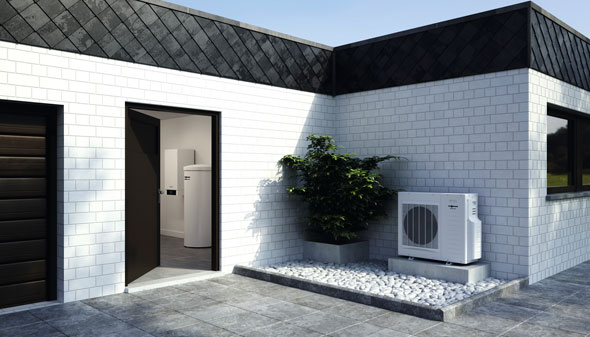
The short answer: a heat pump needs a cylinder with an enlarged coil, around 3–4 square metres, not the ordinary cylinder made for a gas boiler. For a family of four, a 200-litre cylinder is usually enough; with five people or more, or a bath used often, go for 300. The rest of this article explains why, and when you also need a buffer tank.
Why not just any cylinder works with a heat pump
An indirect cylinder heats your domestic water through a coil: a spiral pipe carrying hot water from the heat source. How fast the cylinder heats up depends on two things, the coil's surface area and the temperature difference between the water in the coil and the water in the tank.
A gas boiler sends water into the coil at 70–80 °C. A heat pump works efficiently when it sends water at 50–55 °C. Say you want the tank at 45 °C. With the gas boiler the difference is about 30 degrees; with the heat pump, about 10. Each square metre of coil therefore transfers roughly a third of the heat, and to get the same output you need a coil about three times larger. The exact calculation is more involved, but that is the order of magnitude.
Standard cylinders for gas boilers have small coils. One example you can check: the Elbi BSV 200 has 0.7 m² for 200 litres. The Heizkraft 200-litre heat pump cylinder has 3 m², and the 300-litre version has 4 m².
What happens if you connect a heat pump to an old cylinder
The pump starts and heats the water in the coil, but the coil cannot pass the heat on quickly enough. Water returns to the pump almost as hot as it left, the pump decides the job is done and stops. Then it starts again. The tank stays lukewarm for hours, and to get hot water at all the electric immersion heater kicks in. From that point you pay for hot water as with an electric water heater, while the heat pump, which would have done it far more cheaply, sits idle.
The workaround, raising the flow temperature to make up for the small coil, only works on paper. Chofu R290 heat pumps can push the flow up to 75 °C, but every extra degree lowers efficiency. If you are replacing the heating system anyway, the cylinder is not the place to save money.
How big a heat pump cylinder should be: 200 l or 300 l
A rule widely used in Germany, based on the guidance of the German heat pump association (BWP), starts from 25 litres of water at 60 °C per person per day. For sizing the cylinder the figure is doubled to cover losses and peaks, so 50 litres per person (full explanation, in German). For four people, that gives a 200-litre cylinder.
There is a catch. The rule assumes water stored at 60 °C, while with a heat pump you usually keep it lower, at 45–50 °C, because that is where the pump is efficient. Cooler water gets mixed with less cold water at the tap, so the same cylinder gives fewer litres of shower. That is why, when in doubt, we choose the larger cylinder.
| People in the house | Cylinder | Notes |
|---|---|---|
| 1–3 | 200 l | Comfortable reserve, even with water kept at 45 °C |
| 4 | 200 l | Enough for showers; with a bath used daily, take 300 l |
| 5–6 | 300 l | Showers one after another in the morning |
| over 6 | 300 l or more | Calculated separately, usually with the technician |
Hot water also affects the heat pump's output. In the sizing tool on this site each person adds about 0.2 kW to the heat demand, precisely for the cylinder. For the rest of the calculation, meaning insulation, windows and climate zone, see our article on how to choose the size of a heat pump. For a large house or a guesthouse, where morning hot water matters more than heating, see the example in the article on the 16 kW heat pump.
Legionella and the anti-bacterial cycle
This is the part most people only hear about after installation. Legionella bacteria multiply in standing water between 20 and 45 °C, which is exactly the range where a heat pump keeps the cylinder to stay efficient. The UK Health and Safety Executive (HSE) recommends storing hot water at 60 °C or higher and distributing it at 50 °C or higher. Above 60 °C the bacteria do not survive.
The answer is not to keep the cylinder at 60 °C all the time, but to heat it periodically. The Chofu controller has an anti-legionella function for this, described in the user manual: once a week, on the day and at the hour you choose (1 a.m. by default), it brings the tank to at least 65 °C and holds it there for 10 minutes. The electric heater in the cylinder does the last degrees. If the cycle does not finish within two hours, and this happens repeatedly, the controller shows an alarm.
The practical consequence: the cylinder must have a socket for an electric immersion heater. The Heizkraft cylinders we supply have a 1½-inch connection for it, and the Chofu installation checklist explicitly requires the heater to be fitted in the cylinder.
Cylinder, buffer tank, combined cylinder or hydrobox
Four components that often get mixed up. The cylinder holds domestic hot water, for the shower and the sink. The buffer tank holds water from the heating circuit, the radiators or the underfloor pipes. One does not replace the other.
When you need a buffer tank
The Chofu installation manual requires at least 30 litres of water in the system. Below that, or when the circuit often closes by itself, the pump starts and stops too often. A buffer tank solves this by giving the pump a volume of water to heat steadily. We recommend one with radiators on thermostatic valves, houses split into several zones, and fan coils. With a large underfloor system on a single circuit it is usually not needed. We offer a 100-litre buffer tank.
The cylinder with integrated buffer
One body: the cylinder on top, the buffer below. It takes a single spot in the plant room and is quicker to install. An example from the German manufacturer's catalogue, Thermic Energy WPDS series: the 300/100 model holds 284 litres of domestic water and 100 litres of buffer, with a 3.2 m² coil, 760 mm in diameter and 1,605 mm tall. The trade-off is that you can no longer choose the size of each part. Details on the cylinder with integrated buffer page.
The hydrobox
The hydrobox is a hydraulic module installed indoors, between the heat pump and the heating system, with an electric backup heater. It groups together the parts that would otherwise be mounted one by one on the wall. It does not replace the cylinder: domestic hot water is still stored in a cylinder.
| Option | For whom | Pros | Cons |
|---|---|---|---|
| 200 l cylinder | 1–4 people, showers | 3 m² coil, small footprint | Tight for 4 people with a bath |
| 300 l cylinder | 5–6 people or frequent baths | 4 m² coil, large reserve | Taller, more expensive, slightly higher losses |
| Cylinder with integrated buffer | Radiators with thermostats or several zones, little space | One body, simpler installation | Part sizes are fixed |
| Cylinder + separate buffer | Same cases, with room in the plant room | Each volume chosen separately | Two bodies, more connections |
| Hydrobox | Anyone who wants a compact indoor setup | Hydraulic parts and heater in one module | Does not replace the cylinder |
The cylinders we supply with Chofu heat pumps
We supply Heizkraft single-coil cylinders with an enlarged coil for heat pumps, in 200 and 300 litres, with a double-enamelled tank, magnesium anode and polyurethane foam insulation. You will find them, together with the buffer tank, the combined cylinder and the hydrobox, under cylinders and buffer tanks. The one that fits most often is the 200-litre cylinder. Prices on the site are indicative; in a quote with installation they appear as separate lines next to the heat pump.
We do not recommend connecting a new heat pump to a cylinder with a gas boiler coil, even if you already have one and it feels a shame to remove it. The reason is the one above: the pump would heat the water poorly and the difference would end up on your electricity bill.
Frequently asked questions
Can I keep the cylinder I already have?
Only if its coil is large enough. Look for the coil surface area in its data sheet. Cylinders made for gas boilers usually have under 1 m² at 200 litres, three to four times less than needed.
Will a 150-litre cylinder do?
By the 50-litres-per-person rule, 150 litres covers two or three people if the water is stored at 60 °C. At 45–50 °C, the way a heat pump runs, the reserve gets shorter. We supply 200 and 300 litres, and the size difference compared to 150 is small.
What is the difference between a heat pump water heater and a heat pump cylinder?
A heat pump water heater is a standalone appliance with a small heat pump on top that only heats domestic water. A heat pump cylinder has no pump of its own; it is heated through its coil by the air-to-water heat pump that also heats your house. This article is about the second.
Does the anti-legionella cycle use a lot of power?
It runs once a week, at night, and keeps the water above 65 °C for only 10 minutes. The heater lifts the water from the temperature the pump keeps it at, usually 45–50 °C, to 65 °C. That is 15–20 degrees once a week, not a cylinder heated from cold every day.
Do I need a buffer tank with underfloor heating?
With a large underfloor system on a single circuit, usually not. If it is split into rooms with thermostats that close the circuits, yes, because the water still circulating can drop below the minimum the pump requires.
How long does installing the cylinder take?
A standard heat pump installation takes one day, two if the cylinder goes in at the same time. Both go into the same quote, priced line by line.
Next step
The cylinder is chosen together with the heat pump, not afterwards. If you first want to know what output you need, run the sizing tool; if you already have an idea, ask for a quote and you will get it line by line: heat pump, cylinder, installation, transport.
Next step
Find the heat pump that fits
Same questions, two minutes, no contact details.
Next steps
If you're clear on the output
Your next step depends on where you've got to: the figure for your house, the models that cover it, or who does the installation.
- Work out your house's heat demand Same questions, two minutes, no contact details.
- See the Chofu models From 4 to 16 kW, with the output and coverage for each.
- Who does the installation Certified Chofu partner installers, vetted by NEDAVI. You choose who does the job.