
Guide
4 kW heat pump: for small, very well insulated houses
On two storeys, 4 kW means roughly 47–74 m² of well insulated house with two people. There is no 3 kW model; in four cases the sums lead to 6 kW.
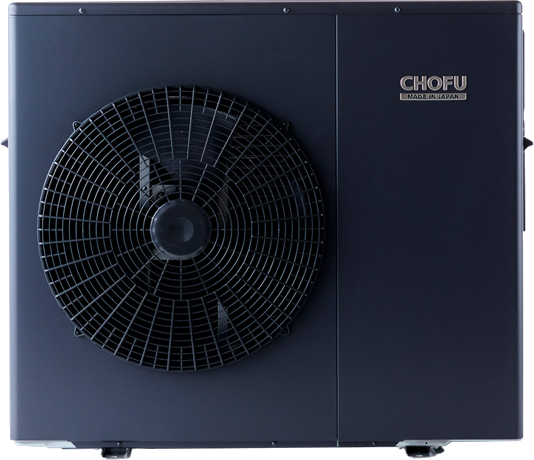
A 4 kW heat pump is the smallest air-to-water unit in the Chofu range. By the formula in our configurator it covers a well insulated house of roughly 47–74 m² on two storeys, with two people, or 42–67 m² on a single storey. With average insulation the range drops to 34–54 m². It is the pump for a passive or nZEB house, a separately heated attic, a holiday home or a small single-storey house. Below are the sums, the data sheet of the R290 Premium 4 kW, what a winter with it costs against direct electric heating, and the four cases where 6 kW is the better choice.
The smallest heat pump: air-to-air or air-to-water
If you search Google for "the smallest heat pump", the first results are air-to-air units, that is air conditioners with a heating mode. They heat the air in one room and nothing else. They give no domestic hot water and cannot feed an underfloor circuit or a radiator.
An air-to-water heat pump does something different: it heats the water in the system, so the whole house, and the water in the cylinder. At Chofu the smallest air-to-water unit has 4 kW. There is no 3 kW model, not in our warehouse and not in the Chofu catalogue. When someone asks us for a "mini heat pump" for a 60 m² house, the conversation ends at the same unit: the Chofu R290 Premium 4 kW.
What size house a 4 kW heat pump is right for
A heat pump is sized on how much heat the house loses on the coldest day of winter, not on floor area alone. On the sizing page we use the formula explained in how to size a heat pump:
kW = floor area × W/m² ÷ 1000 × (ceiling height ÷ 2.6 m) × storey factor + people × 0.2 kW
The values are 55 W/m² for a well insulated house, 75 W/m² for average insulation and 100 W/m² for a poorly insulated one. The storey factor is 1.10 for a single-storey house, 1.00 for two storeys and 0.95 with a lived-in attic on top. The 0.2 kW per person is for hot water.
Two limits decide whether 4 kW is the answer. The configurator allows a pump up to 10% below the demand, so 4 kW covers a demand of up to 4 ÷ 0.9 = 4.44 kW. And it warns when the pump exceeds 1.35 times the demand, so below 4 ÷ 1.35 = 2.96 kW even the smallest pump is too big. For two people, with 0.4 kW for hot water, that leaves between 2.56 and 4.04 kW for space heating. The floor areas in the table follow from that.
| Insulation | Single storey | Two storeys | Two storeys and attic |
|---|---|---|---|
| Well insulated (55 W/m²) | 42–67 m² | 47–74 m² | 49–77 m² |
| Average insulation (75 W/m²) | 31–49 m² | 34–54 m² | 36–57 m² |
| Poorly insulated (100 W/m²) | 23–37 m² | 26–40 m² | 27–43 m² |
On the product page we say the 4 kW model covers a flat or a small, well insulated house of up to 70 m². That figure is for three people: (4.44 − 0.6) ÷ 0.055 = 69.9 m². With two people the upper end rises to 74 m², with four it drops to 66 m². Below the lower end of the range even 4 kW is no longer right: the pump would start and stop often. Above the upper end the 6 kW heat pump comes into the picture.
Worked example: a 60 m² single-storey house
Take a 60 m² house on one storey, 2.6 m ceilings, 15 cm of polystyrene on the walls, 30 cm of wool in the loft, triple glazing and underfloor heating. The configurator rates it "well insulated". Two people live there.
- Space heating: 60 × 55 ÷ 1000 = 3.3 kW. Single storey: 3.3 × 1.10 = 3.63 kW.
- Hot water: 2 × 0.2 = 0.4 kW. Total demand: 4.03 kW.
- The 4 kW pump gives 4 ÷ 4.03 = 0.99 of the demand. It is 1% under, within the 10% tolerance, so it passes.
- The 6 kW pump would be 6 ÷ 4.03 = 1.49 times the demand, above the 1.35 limit. The configurator does not suggest it.
The same house with three people needs 4.23 kW, and 4 kW gives 0.95 of the demand: still a pass. If the same house has 5 cm of polystyrene on the walls, 8 cm of wool in the loft and double glazing, the configurator moves it to "average insulation" and the demand jumps to 60 × 75 ÷ 1000 × 1.10 + 0.4 = 5.35 kW. Then 4 kW covers only 75% and the answer becomes 6 kW, which gives 1.12 of the demand. In a small house, the thickness of the insulation alone moves the model.
Who chooses a 4 kW heat pump
The passive or nZEB house. A carefully built new house loses little: at 55 W/m², a 70 m² house on two storeys needs 3.85 kW for space heating. A bigger model would be a mistake, not a reserve.
The separately heated attic or flat. When the upper part of the house has its own system and its own cylinder, 4 kW is usually enough. The unit measures 886 × 1000 × 330 mm and weighs 66 kg, so it sits on a terrace or on a wall bracket.
The holiday home. The pump keeps the house at a reduced temperature while you are away, without anyone carrying firewood, and it runs down to −20 °C outside. If the house is not insulated like a new one, the table shows that 4 kW only reaches 40 m² on two storeys; above that, the sums lead to 6 kW.
The small single-storey house with one or two people. That is the example above. Hot water for two people takes 0.4 kW of the 4, with a 200 litre cylinder with an enlarged coil.
Chofu R290 Premium 4 kW: the data sheet, next to the 6 kW model
The Chofu R290 Premium 4 kW is an air-to-water monobloc: the whole refrigerant circuit sits in the outdoor unit, and only water pipes come into the house. It has the same cabinet as the 6 kW model of the same range, which we put next to it, because that is the choice most people end up making. The figures come from the Chofu data sheets.
| Specification | R290 Premium 4 kW | R290 Premium 6 kW |
|---|---|---|
| Model code | AEYC-0449ZU-CH1 | AEYC-0649ZU-CH1 |
| Refrigerant | R290 (propane), 0.50 kg | R290 (propane), 0.85 kg |
| Maximum flow temperature | 75 °C | 75 °C |
| COP at +7 °C outside, 35 °C flow | 4.60 | 4.88 |
| SCOP at 35 °C / 55 °C | 4.48 / 3.31 | 4.46 / 3.43 |
| Energy class 35 °C / 55 °C | A+++ / A++ | A+++ / A++ |
| Output at −7 °C, 35 °C flow | 4.0 kW, COP 2.60 | 6.0 kW, COP 2.86 |
| Power input at +7 °C | 0.87 kW | 1.23 kW |
| Running current | 3.8 A (max. 12.0 A) | 5.3 A (max. 16.6 A) |
| Sound power | 54 dB(A) | 54 dB(A) |
| Dimensions (H × W × D) | 886 × 1000 × 330 mm | 886 × 1000 × 330 mm |
| Weight | 66 kg | 82 kg |
The figure that matters most is the one at −7 °C: the 4 kW model gives all 4 kW in the cold too, at full load, with a COP of 2.60. That means 4.0 ÷ 2.60 = 1.54 kW drawn from the grid in the hardest hour. At +7 °C it draws 0.87 kW. It runs single-phase, at 230 V, with 3.8 A, so it needs nothing special in the fuse board.
Because it heats water to 75 °C, it also works with standard radiators. The refrigerant is R290, propane, with a GWP of 3. From 1 January 2027, Regulation (EU) 2024/573 no longer allows new monobloc heat pumps of up to 12 kW with refrigerants of GWP 150 or more to be placed on the market (EUR-Lex, Annex IV). R290 is not covered by that rule, and at 4 kW Chofu does not have an R32 model anyway. The difference between the two refrigerants is explained in R290 vs R32: the real difference. The warranty is 3 years on the unit and 5 years on the compressor, with the yearly service done.
When the 6 kW pump is the better choice
The configurator suggests the smallest model that covers the demand, and between 2.96 and 4.44 kW that is 4 kW. There are, however, four cases where the sums, done properly, lead to the R290 Premium 6 kW.
3 m ceilings. The formula multiplies by height ÷ 2.6, that is 1.15. The 60 m² house in the example rises to 3.63 × 3 ÷ 2.6 + 0.4 = 4.59 kW. The 4 kW pump would cover only 87%, while 6 kW gives 1.31 of the demand, under the 1.35 limit.
Climate zone III. The W/m² values are not adjusted by zone. In Cluj, Sibiu or Iași you size for −18 °C instead of −15 °C, about 9% more output. The same 60 m² house needs 4.34 kW there with two people, and 4.54 kW with three, above what 4 kW covers.
Hot water for more people. While the pump heats the cylinder, it does not heat the house. With a 4 kW pump on a −7 °C day, the house in the example needs almost all the output for space heating, so the cylinder recovers slowly. With three or four people showering one after another, the extra 2 kW of the 6 kW model are felt.
The upper edge of the range. If the demand comes out between 4.2 and 4.4 kW, the 4 kW pump runs at full output every cold day and has no reserve left. The 6 kW pump, in the same house, runs at part load. The reverse also holds: for a demand under 4.44 kW, 6 kW is already more than 1.35 times the demand and the configurator warns. What COP and SCOP mean in these operating conditions is in our article on COP and SCOP of a heat pump.
How much electricity a 4 kW heat pump uses in a year
We work it out as in what a winter with a heat pump costs: heating output × 1,980 equivalent hours a year (Eurostat degree days for climate zone II, −15 °C: Oradea, Arad, Bucharest) ÷ SCOP × electricity price. For the 60 m² house in the example, space heating needs 3.63 kW, so 3.63 × 1,980 = 7,187 kWh of heat a year, hot water excluded. We put the same heat through a direct electric boiler too, with an efficiency of 1.0, because in a small house many people choose one out of convenience.
| System | SCOP or efficiency | Electricity a year | At 1.35 lei/kWh | At 1.11 lei/kWh |
|---|---|---|---|---|
| R290 Premium 4 kW, underfloor 35 °C | 4.48 | 1,604 kWh | 2,166 lei | 1,781 lei |
| R290 Premium 4 kW, radiators 55 °C | 3.31 | 2,171 kWh | 2,931 lei | 2,410 lei |
| Direct electric heating | 1.0 | 7,187 kWh | 9,703 lei | 7,978 lei |
The electricity prices are the ones in our calculator, VAT included: 1.35 lei/kWh (PPC Fix Online, September 2026) and 1.11 lei/kWh (Hidroelectrica Viitor Hidro, Muntenia, 01.07–30.09.2026). On underfloor heating, the 4 kW pump saves 9,703 − 2,166 = 7,537 lei a year against direct electric heating, at 1.35 lei/kWh. On radiators, 6,772 lei. The figures are an upper bound: the method does not subtract sunshine through the windows or the heat people and appliances give off. The ratio between the two stays the same, though, because both systems heat the same house.
How much a 4 kW heat pump costs
The list price of the R290 Premium 4 kW is 3,361 € including VAT, at the date of publication. The product page also shows it in lei, recalculated daily at the National Bank rate; at the 5.26 lei/€ used in our calculator that comes to about 17,679 lei. All sizes are on the heat pumps page.
The final sum also includes the 200 litre cylinder with an enlarged coil, the hydraulic kit, the expansion vessel, the controller with room thermostat, installation and commissioning. They depend on the house, so we do not write them here: they appear as line items in the quote. Send the details of the house on the quote page and you get the itemised quote within one working day.
Frequently asked questions
What is the smallest air-to-water heat pump?
At Chofu, the R290 Premium 4 kW. It gives 4.0 kW at −7 °C, heats water to 75 °C, has a sound power of 54 dB(A) and weighs 66 kg. The smaller units Google shows are air-to-air: they heat the air in one room and give no hot water.
Is there a 3 kW heat pump?
Not in the Chofu range. The smallest is 4 kW. For a house that needs less than 2.96 kW, even 4 kW goes over the oversizing limit of 1.35 times the demand, but such a house is usually under 47 m² on two storeys and very well insulated.
What heat pump do I need for 60 m²?
It depends on insulation and storeys. A well insulated 60 m² house on a single storey, with two people, needs 4.03 kW and matches 4 kW. The same house with average insulation needs 5.35 kW and moves to 6 kW. Enter your details in the sizing calculator and see the figure for your house.
Does a 4 kW heat pump work for a holiday home?
Yes, if the house falls within the range in the table: up to 74 m² well insulated on two storeys, up to 40 m² if poorly insulated. The advantage is that the pump keeps the house at a reduced temperature while you are away, with no fire and no firewood, and runs down to −20 °C outside.
How much power does a 4 kW heat pump draw per hour?
At +7 °C outside and 35 °C flow, 0.87 kW. At −7 °C, at full output, about 1.54 kW. Over a year, the 60 m² house in the example uses about 1,600 kWh of electricity on underfloor heating, against 7,187 kWh with direct electric heating.
Check whether 4 kW is enough for your house
Enter the floor area, insulation, storeys and number of people in the configurator. In two minutes you see whether you land on 4 or 6 kW and what a winter will cost. If you want the final figure with installation straight away, send us the details of the house.
Next step
Find the heat pump that fits
Same questions, two minutes, no contact details.
Next steps
If you're clear on the output
Your next step depends on where you've got to: the figure for your house, the models that cover it, or who does the installation.
- Work out your house's heat demand Same questions, two minutes, no contact details.
- See the Chofu models From 4 to 16 kW, with the output and coverage for each.
- Who does the installation Certified Chofu partner installers, vetted by NEDAVI. You choose who does the job.