
Guide
Heat pump for a 120 m² house: what size, which Chofu model and what heating costs
Well insulated, with four people, a 120 m² house needs 7.4 kW and gets the 8 kW pump. Average insulation takes it to 10 kW, and 6 kW is enough only without hot water on the pump.
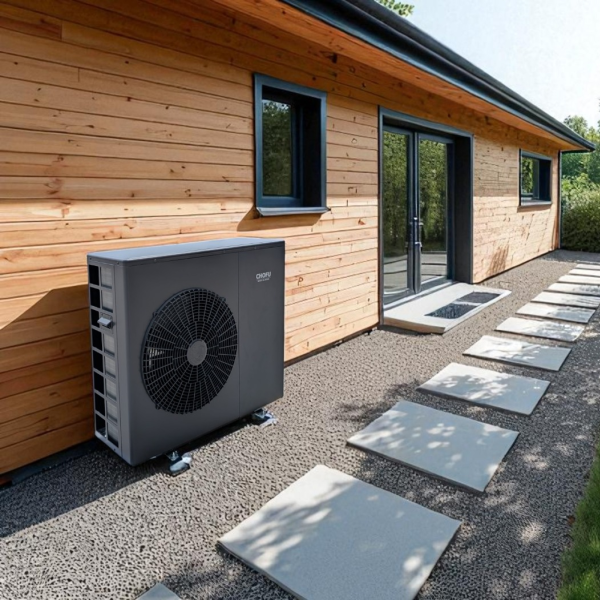
By the formula in our configurator, an air-to-water heat pump for a 120 m² house comes to 8 kW if the house is well insulated, 10 kW with average insulation and 12 kW if it is poorly insulated, with hot water for four people counted in. The 6 kW size is enough only when the hot water is not on the heat pump. The Chofu models that fit are the R290 Standard 8 kW for the usual case, the R290 Premium 10 kW or R32 10 kW for average insulation and the R290 Standard 12 kW or R32 12 kW for an old house, with the note that on radiators only the R290 models remain. Below are the sums for each case, the prices with VAT and what a winter costs compared with gas.
How many kW a 120 m² house needs: the configurator formula
The output is not read off the floor area alone. It is worked out from how much heat the house loses on the coldest day, and that depends on the insulation, the shape of the house and how many people shower in the morning. On the sizing page we use the formula we explain step by step in how to size a heat pump:
kW = floor area × W/m² ÷ 1000 × (ceiling height ÷ 2.6 m) × storey factor + people × 0.2 kW
The specific loss is 55 W/m² for a well insulated house, 75 W/m² for average insulation and 100 W/m² for a poorly insulated one. The storey factor is 1.10 for a single storey, 1.00 for two storeys and 0.95 with a lived-in attic. Hot water adds 0.2 kW per person. The configurator accepts a pump up to 10% below the demand, so 6 kW covers up to 6.67 kW, 8 kW up to 8.89 kW, 10 kW up to 11.11 kW and 12 kW up to 13.33 kW.
For 120 m², 2.6 m ceilings and four people, the table comes out like this:
| Insulation | Single storey (× 1.10) | Two storeys (× 1.00) | Two storeys and attic (× 0.95) |
|---|---|---|---|
| Well insulated (55 W/m²) | 8.06 kW, 8 kW model | 7.4 kW, 8 kW model | 7.07 kW, 8 kW model |
| Average insulation (75 W/m²) | 10.7 kW, 10 kW model | 9.8 kW, 10 kW model | 9.35 kW, 10 kW model |
| Poorly insulated (100 W/m²) | 14.0 kW, 16 kW model | 12.8 kW, 12 kW model | 12.2 kW, 12 kW model |
The result is simpler than the table looks. Insulation decides the model; the shape of the house only moves the figure within the same model. The one exception is the poorly insulated single-storey house, where 14.0 kW goes past 13.33 and the configurator suggests 16 kW, and on radiators asks first for insulation or two units in cascade.
Worked example: 120 m² on two storeys, well insulated, four people
The typical house behind these searches: built after 2010, with 10 cm of polystyrene on the walls, 15–20 cm of wool in the loft and double or triple glazing. The configurator rates it "well insulated". Four people live there, and the cylinder is on the heat pump.
- Space heating: 120 × 55 ÷ 1000 × 1.00 = 6.6 kW.
- Hot water: 4 × 0.2 = 0.8 kW. Total demand: 7.4 kW.
- The 6 kW pump covers at most 6.67 kW, so it falls short.
- The 8 kW pump gives 8 ÷ 7.4 = 1.08 times the demand, an 8% margin. The oversizing limit is 1.35, so we are nowhere near it.
- On a single storey the demand rises to 8.06 kW, with an attic it drops to 7.07 kW. Still 8 kW.
This is also where the answer to the 6 kW question comes from. Without hot water on the pump, say with an electric cylinder or solar panels that stay in place, the demand is 6.6 kW, and 6 kW just covers it: 6 ÷ 6.6 = 0.91, right above the 0.9 threshold. It is a real case, but a narrow one. At the timber frame house in Bihor, 110 m², well insulated, with underfloor heating, we fitted a 6 kW pump in 2023. At 120 m² and four showers a day, the threshold is passed. Each size has its own article: the 6 kW heat pump, the 8 kW heat pump and, for average insulation, the 10 kW heat pump.
Air-to-water heat pump for a 120 m² house: which Chofu model fits
Every Chofu heat pump is an air-to-water monobloc: only water comes into the house, no refrigerant. For 120 m² three sizes come into question and, for each, one or two models. The figures below come from the Chofu data sheets and the EU EPREL database. The prices are the catalogue prices, with VAT, at the date of publication, and they move with the exchange rate.
| Model | Case | Max. flow | Output at −7 °C | Noise | Price with VAT |
|---|---|---|---|---|---|
| R290 Standard 8 kW | well insulated, 7.07–8.06 kW | 75 °C | 6.16 kW, part load | 57 dB(A) | 19,583 lei |
| R290 Premium 6 kW | well insulated, no hot water on the pump, 6.27–6.6 kW | 75 °C | 6.0 kW, full load | 54 dB(A) | 20,530 lei |
| R290 Standard 6 kW | well insulated, no hot water on the pump, 6.27–6.6 kW | 75 °C | 4.71 kW, part load | 56 dB(A) | 17,269 lei |
| R32 6 kW | well insulated, no hot water on the pump, underfloor | 60 °C | 3.86 kW, part load | 60 dB(A) | 13,366 lei |
| R290 Premium 10 kW | average insulation, 9.35–10.7 kW | 75 °C | 10.0 kW, full load | 54 dB(A) | 26,726 lei |
| R32 10 kW | average insulation, underfloor | 60 °C | 6.88 kW, part load | 64 dB(A) | 17,821 lei |
| R290 Standard 12 kW | poorly insulated, 12.2–12.8 kW | 75 °C | 9.90 kW, part load | 59 dB(A) | 25,495 lei |
| R32 12 kW | poorly insulated, underfloor | 60 °C | 8.61 kW, part load | 62 dB(A) | 21,003 lei |
The output at −7 °C is not measured the same way everywhere. For the Premium models, Chofu declares the output at full load. For the Standard and R32 models only the part load point from the EN 14825 test is published, which follows the declared load, not the maximum of the unit. All of them run down to −20 °C outside and carry the same warranty: 3 years on the unit and 5 years on the compressor, with the yearly service done. The 8 kW pump in the Sălaj project was started in January 2024 at −12 °C and carried the house without the backup heater.
Which heat pump for 120 m² with radiators
If the rooms still have the radiators from the old boiler, the configurator keeps only the models that heat water to 75 °C, that is the R290 range. The R32 stops at 60 °C. For the well insulated house that means the R290 Standard 8 kW, for average insulation the R290 Premium 10 kW, for the old house the R290 Standard 12 kW. On radiators the SCOP at 55 °C is used: 3.5 for the Standard 8 kW, 3.61 for the Premium 10 kW, 3.6 for the Standard 12 kW. Whether your radiators really keep the house warm with water at 55 °C is checked room by room, with the method in heat pumps with old radiators.
With underfloor heating: the R32 too, with the note about 2027
With underfloor heating the R32 comes into question as well, and it costs less: 13,366 lei at 6 kW, 17,821 lei at 10 kW, 21,003 lei at 12 kW, with VAT, at the date of publication. On underfloor heating the SCOP at 35 °C is almost the same for R32 and R290, so the winter bill differs little. What differs is the deadline. From 1 January 2027, Regulation (EU) 2024/573 no longer allows new monobloc heat pumps of up to 12 kW with refrigerants of GWP 150 or more to be placed on the market. R32 has a GWP of 675; R290 has a GWP of 3. An R32 pump already installed stays legal and can still be repaired. The full comparison is in R290 or R32: the real difference.
What heating a 120 m² house with a heat pump costs, compared with gas
Take the house from the example, well insulated, on two storeys, with the 8 kW pump. We work it out as in what a winter with a heat pump costs, with the configurator's method: heating output, without the hot water share, × 1,977 equivalent hours a year (climate zone II: Oradea, Arad, Bucharest) × gains factor 1.0 ÷ efficiency × energy price.
- Heat required: 6.6 kW × 1,977 h × 1.0 = 13,048 kWh a year.
- Heat pump on underfloor heating, SCOP 4.68 at 35 °C: 13,048 ÷ 4.68 = 2,788 kWh of electricity. At 1.35 lei/kWh: 3,764 lei.
- Heat pump on radiators, SCOP 3.61 at 55 °C: 13,048 ÷ 3.61 = 3,614 kWh. At 1.35 lei/kWh: 4,880 lei.
- Condensing gas boiler, efficiency 0.92: 13,048 ÷ 0.92 = 14,183 kWh of gas. At 0.28 lei/kWh: 3,971 lei.
| System | Efficiency or SCOP | Energy a year | Energy price | Cost a year |
|---|---|---|---|---|
| Heat pump, underfloor 35 °C | 4.68 | 2,788 kWh electricity | 1.35 lei/kWh | 3,764 lei |
| Heat pump, underfloor 35 °C, cheap contract | 4.68 | 2,788 kWh electricity | 1.11 lei/kWh | 3,095 lei |
| Heat pump, radiators 55 °C | 3.61 | 3,614 kWh electricity | 1.35 lei/kWh | 4,880 lei |
| Condensing gas boiler | 0.92 | 14,183 kWh gas | 0.28 lei/kWh | 3,971 lei |
| Pellet boiler | 0.75 | 17,398 kWh pellets | 0.471 lei/kWh | 8,194 lei |
| Beech firewood boiler | 0.75 | 17,398 kWh wood | 0.186 lei/kWh | 3,236 lei |
SCOP 4.68 and 3.61 are the KEYMARK certified figures the configurator uses for Chofu. The R290 Standard 8 kW has SCOP 4.5 at 35 °C and 3.5 at 55 °C on its own data sheet, a little lower: with it, the same house comes to 2,900 kWh and 3,914 lei on underfloor heating, 3,728 kWh and 5,033 lei on radiators. The point where the heat pump beats gas can be worked out directly: a kWh of heat from gas costs 0.28 ÷ 0.92 = 0.304 lei; multiplied by the SCOP, the heat pump is cheaper below 1.42 lei/kWh on underfloor heating and below 1.10 lei/kWh on radiators. On underfloor heating it wins on almost any electricity contract. On radiators at 55 °C, only with a cheap contract.
The figures are an upper bound: the degree-day method does not subtract sunshine through the windows or the heat given off inside the house. Insulation moves the bill more than the model does. The house with average insulation needs 9.0 kW × 1,977 = 17,793 kWh, that is 3,802 kWh of electricity and 5,133 lei on underfloor heating; the poorly insulated one 23,724 kWh, 5,069 kWh and 6,843 lei. On gas, the same houses would cost 5,415 and 7,220 lei.
How much a heat pump for 120 m² costs
The unit alone: 19,583 lei for the R290 Standard 8 kW, the usual case. For average insulation, 26,726 lei for the R290 Premium 10 kW or 17,821 lei for the R32 10 kW on underfloor heating. For the old house, 25,495 lei for the R290 Standard 12 kW or 21,003 lei for the R32 12 kW. All with VAT, at the date of publication, on the heat pumps page.
The final sum also includes a hot water cylinder with an enlarged coil, sometimes a buffer tank, materials and installation, which depend on the house: the distance to the plant room, the system you already have, whether the radiators stay. We do not publish an installation total, because there is none that holds for every 120 m² house. It appears item by item in the quote, after you send the details of the house on the quote page.
What changes the answer: ceiling height, climate zone and old windows
Ceiling height goes straight into the formula. At 3.0 m instead of 2.6 m, the well insulated house needs 6.6 × 3.0 ÷ 2.6 = 7.62 kW of heating, 8.42 kW with hot water: it stays at 8 kW. At 3.5 m, as in an old house with high ceilings, it rises to 8.88 kW and 9.68 kW in total, which means 10 kW.
The climate zone does not change the W/m² in the configurator, but it changes the hours and the design temperature. Zone II (Oradea, Arad, Bucharest) is calculated at −15 °C and 1,977 hours; zone I (Constanța) at −12 °C and 2,175 hours; zone III (Cluj, Sibiu, Iași) at −18 °C and 1,813 hours. In Cluj, the coldest day asks for about 9% more output (36 ÷ 33 degrees of difference from 18 °C indoors), so a house at the top of the 8 kW range can move to 10 kW. The winter is shorter, though: 2,557 kWh of electricity on underfloor heating against 2,788 in zone II. All Chofu heat pumps are guaranteed down to −20 °C outside.
Windows matter more than people think. The configurator does not ask "how well is the house insulated", it asks what is on it: walls count as "well insulated" from 10 cm of polystyrene, the loft from 15 cm, and the windows go in as triple glazing (good), double glazing (average) or old joinery (poor). The final grade is the weighted average of the three, rounded. A house with good walls and loft but old windows can land on "average insulation" and go from 8 kW to 10 kW. If you are replacing the windows next year, size for the house as it will be then, not as it is now.
Frequently asked questions
How many kW does a 120 m² house need?
With four people and 2.6 m ceilings: 7.07–8.06 kW if well insulated (8 kW model), 9.35–10.7 kW with average insulation (10 kW) and 12.2–12.8 kW if poorly insulated (12 kW). The bottom of each range is the house with an attic, the top is the single-storey house.
Which heat pump for 120 m² with radiators?
An R290 model, which heats water to 75 °C: the R290 Standard 8 kW for the well insulated house, the R290 Premium 10 kW for average insulation, the R290 Standard 12 kW for the old house. The R32 models stop at 60 °C and are not suggested for radiators.
How much does a heat pump use over a winter at 120 m²?
The well insulated house, zone II: 13,048 kWh of heat, that is 2,788 kWh of electricity on underfloor heating (3,764 lei at 1.35 lei/kWh) or 3,614 kWh on radiators at 55 °C (4,880 lei). With average insulation, about 3,800 kWh on underfloor heating.
How much does a heat pump for 120 m² cost?
The unit: 19,583 lei for the R290 Standard 8 kW, 26,726 lei for the R290 Premium 10 kW, 17,821 lei for the R32 10 kW, with VAT, at the date of publication. The cylinder, buffer tank, materials and installation come on top and appear item by item in the quote.
Is 6 kW enough for 120 m²?
Only if the house is well insulated, on two storeys or with an attic, and the hot water is not on the heat pump: the 6.6 kW demand sits just under the 6.67 kW threshold. With the cylinder on the pump and four people, the demand is 7.4 kW and you need 8 kW.
Check the figure for your house
Enter in the sizing calculator the floor area, what is on the walls and in the loft, the windows, the storeys and how many of you live there. In two minutes you see whether you need 6, 8 or 10 kW and what a winter costs at your tariff. If you want the final figure with installation straight away, send us the details of the house.
Next step
Find the heat pump that fits
Same questions, two minutes, no contact details.
Next steps
If you're clear on the output
Your next step depends on where you've got to: the figure for your house, the models that cover it, or who does the installation.
- Work out your house's heat demand Same questions, two minutes, no contact details.
- See the Chofu models From 4 to 16 kW, with the output and coverage for each.
- Who does the installation Certified Chofu partner installers, vetted by NEDAVI. You choose who does the job.