
Technical
Single-phase or three-phase heat pump: when you need 380 V
A three-phase pump does not use less, it only spreads the current over three phases. See the amps of each model, what your connection approval says and when a power increase is worth it.
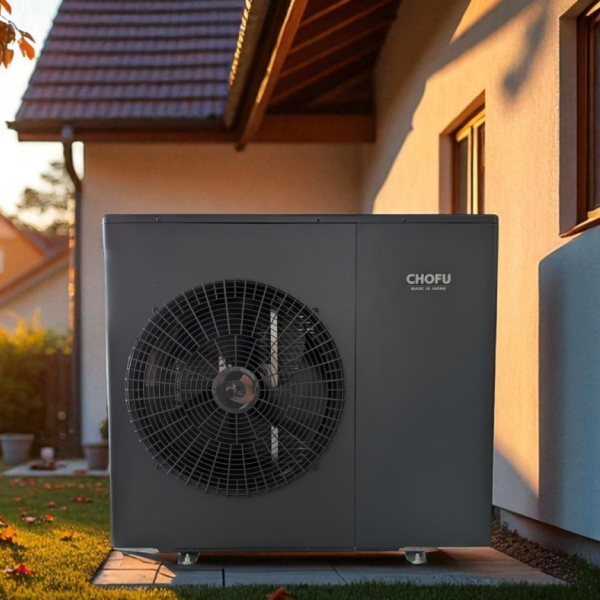
You only need a three-phase heat pump if you already have a three-phase grid connection, or if the pump, added to the rest of the house, no longer fits into the power approved on one phase. The three-phase version does not use less: on the Chofu data sheets it draws about 5% more for the same heat. What you gain is a current three times lower on each phase.
Which three-phase heat pumps Chofu makes
Of the 13 Chofu models, three come in a three-phase version, with the same output, the same casing and the same refrigerant as their single-phase twin:
- 10 kW R290 Premium three-phase (AEYC-1050ZU3-CH1), propane, flow water up to 75 °C;
- 12 kW R290 Standard three-phase (AEYC-1250ZU3-CH), propane, also 75 °C;
- 16 kW R32 three-phase (AEYC-1642XU3-CH), up to 60 °C flow.
The 4, 6 and 8 kW models are single-phase only. At those sizes there would be no point in anything else: the highest maximum current among them is 16.6 A. The website and catalogue say 380 V; the installation manual of the 16 kW model gives 400 V, three phases plus neutral, with a tolerance of 360 to 440 V. It is the same three-phase supply you have at home, just an older name for it. A three-phase unit cannot run on a single-phase supply: it needs all three phases.
Current draw of each model
The figures below come from the Chofu data sheets, at +7 °C outside and 35 °C flow. The breaker column comes from the installation manuals: Chofu requires a dedicated circuit for every pump, with a breaker of the size in the table and a 30 mA residual current device. For the two three-phase R290 models, the manual we have does not state the breaker, so we left it out.
| Model | Supply | Rated current | Maximum current | Power input at A7/W35 | Breaker per manual |
|---|---|---|---|---|---|
| 4 kW R290 Premium | 230 V | 3.8 A | 12.0 A | 0.87 kW | 16 A |
| 6 kW R290 Standard | 230 V | 5.7 A | 12.0 A | 1.31 kW | 16 A |
| 6 kW R290 Premium | 230 V | 5.3 A | 16.6 A | 1.23 kW | 20 A |
| 6 kW R32 | 230 V | 6.3 A | 11.2 A | 1.43 kW | 16 A |
| 8 kW R290 Standard | 230 V | 7.4 A | 16.6 A | 1.70 kW | 20 A |
| 10 kW R290 Premium | 230 V | 8.8 A | 24.0 A | 2.02 kW | 25 A |
| 10 kW R290 Premium three-phase | 400 V, 3 phases | 3.2 A per phase | 8.0 A per phase | 2.12 kW | not published |
| 10 kW R32 | 230 V | 10.1 A | 17.5 A | 2.28 kW | 20 A |
| 12 kW R290 Standard | 230 V | 10.7 A | 24.0 A | 2.45 kW | 25 A |
| 12 kW R290 Standard three-phase | 400 V, 3 phases | 3.9 A per phase | 8.0 A per phase | 2.57 kW | not published |
| 12 kW R32 | 230 V | 12.2 A | 23.0 A | 2.79 kW | 32 A |
| 16 kW R32 | 230 V | 16.3 A | 25.3 A | 3.72 kW | 32 A |
| 16 kW R32 three-phase | 400 V, 3 phases | 6.0 A per phase | 9.0 A per phase | 3.90 kW | 20 A |
What the table shows: up to 8 kW, every model draws at most 16.6 A. The single-phase R290 units of 10 and 12 kW and the R32 units of 12 and 16 kW peak at 23–25.3 A, which is 5.3–5.8 kVA on a single phase. The three-phase units stay at 8–9 A per phase. The total power taken from the grid is almost the same; it is just split three ways.
What your grid connection allows
The Romanian regulator's rules on connection solutions say that a single-phase connection is used for powers of up to 11 kVA. Above that, and below 30 kVA, the distribution operator gives you a three-phase connection (ANRE Order no. 102/2015, art. 7, checked on 27.09.2026). 11 kVA at 230 V means at most about 48 A on the phase, for the whole house.
Your approved power is not necessarily 11 kVA. You will find it in the technical connection approval (aviz tehnic de racordare, ATR) or in the connection certificate of your supply point. Look there before you choose the pump, not after. The Chofu manual says the same thing, more drily: the supply capacity must cover the pump's current plus that of the other appliances, and if it does not, the contracted capacity has to be increased.
Breakers, cable and residual current protection
The pump needs its own circuit straight from the distribution board, with no socket shared with other appliances and no extension lead. For the single-phase 16 kW, the manual asks for a 32 A breaker and a cable of at least 4 mm²; for the three-phase 16 kW, a 20 A breaker and at least 1.5 mm² per phase. For the single-phase R290 units of 10 and 12 kW, 25 A and 2.5 mm². In every case, a 30 mA residual current device and a switch that disconnects all poles. The electrician doing the installation sizes these from the model's manual and the current standards, not from our table.
The single-phase R32 units of 10, 12 and 16 kW also carry a grid condition in the manual: the impedance at the connection point must be at most 0.354 Ω (10 and 12 kW) or 0.306 Ω (16 kW). It matters for houses at the end of a line, where the voltage already drops in winter. If you have voltage problems, ask the operator before you order.
Example: a 150 m² house on radiators, single-phase connection
Take a 150 m² house, average insulation, ground floor and first floor, four people, radiators. With the formula from the configurator: 150 × 75 ÷ 1000 + 4 × 0.2 = 12.05 kW. The 10 kW model covers up to 11.1 kW, so it is not enough. On radiators only the R290 pumps remain, because they heat the water to 75 °C. The answer is the 12 kW R290 Standard, and the version is still to be chosen.
- Single-phase: it normally draws 10.7 A and at most 24.0 A, on a 25 A breaker. If the supply point has 11 kVA approved, about 48 A, the pump needs half of it at peak. That leaves roughly 24 A for the hob, oven, electric water heater, washing machine and everything else. It works, but you need to know what you switch on at the same time. With a lower approved power, the margin gets even tighter.
- Three-phase: for the same draw from the grid, 3.9 A normally and at most 8.0 A on each phase. If you already have three-phase, this is the obvious choice.
- If you are on single-phase and it is not enough: either you apply for a power increase, or you check whether better insulation would bring the demand below 11.1 kW, to the 10 kW model. The details for this size are in the article on the 12 kW heat pump.
Is a three-phase heat pump more efficient?
No. It is a common belief, but the data sheets say the opposite. At the same heat output and the same operating point, each three-phase version draws almost 5% more from the grid than its single-phase twin.
| Model | Input, single-phase | Input, three-phase | COP, single-phase | COP, three-phase | Difference |
|---|---|---|---|---|---|
| 10 kW R290 Premium | 2.02 kW | 2.12 kW | 4.95 | 4.72 | +5% |
| 12 kW R290 Standard | 2.45 kW | 2.57 kW | 4.90 | 4.67 | +5% |
| 16 kW R32 | 3.72 kW | 3.90 kW | 4.30 | 4.10 | +5% |
COP is a single snapshot, at +7 °C. For the whole season we only have figures at 16 kW: SCOP 4.5 single-phase and 4.1 three-phase at 35 °C, while at 55 °C both are 3.2. For a house that needs 15 kW, on underfloor heating, that is about 8,910 lei a year against 9,779 lei at 1.35 lei/kWh; the full calculation is in the article on the 16 kW heat pump. The two three-phase R290 units are not registered in EPREL and their data sheet gives no SCOP or energy class, so we do not estimate them.
So you choose three-phase for the grid connection, not for the bill. If you have three-phase at home and the single-phase pump fits comfortably on one phase, you can fit the single-phase unit too: it uses slightly less, and the electrician connects it to the least loaded phase.
Moving to three-phase: a power increase
If the pump does not fit into what you have approved, you ask the distribution operator for a power increase (spor de putere). For homes, the rules are in the ANRE procedure for connecting household customers (ANRE Order no. 18/2022, checked on 27.09.2026), and power increases are covered there too. If the new power goes above 11 kVA, the increase in practice means a three-phase connection, with a three-phase meter.
We cannot honestly tell you what it costs: it depends on the operator, the distance to the network and the work needed, and you find the amount in the technical approval. What we do know is that, for household customers, the law requires the operator to reimburse, within at most five years, the value of the connection work paid by the customer, up to the average values set by ANRE (Law no. 248/2022, explained on avocatnet.ro, checked on 27.09.2026). Ask the operator in writing whether this applies to your work as well.
Two practical tips. File the application before you order the pump, because it takes longer than the delivery. And if you are also thinking about solar panels, discuss both projects with the electrician at once, so you do not end up filing two applications with the operator a few months apart.
Three-phase heat pump at 6, 8, 10 or 12 kW
Many people search for a three-phase heat pump of 6 or 8 kW. The Chofu range does not have one, and you do not need it: 6 kW draws at most 11.2–16.6 A depending on the model, and 8 kW at most 16.6 A. On a three-phase connection, the electrician puts it on one phase and that is it.
At 10 kW, single-phase works on almost any household connection; the three-phase version makes sense when you already have three-phase. More in the article on the 10 kW heat pump. At 12 kW, with 24 A at peak, you reach the point where the approved power is worth checking. At 16 kW, three-phase is often the natural choice.
Above 16 kW we are no longer talking about one unit but about two or three in cascade. There, three-phase helps in a different way: the electrician can put each single-phase unit on a different phase. That is how the system at guesthouses with cascaded pumps is designed.
One more thing to know for 2027. The only three-phase 16 kW unit runs on R32, and from 1 January 2027 new monobloc heat pumps with R32 can no longer be placed on the EU market (Regulation (EU) 2024/573). Units already installed stay legal and can be serviced, and stock placed on the market before then can still be sold. The two three-phase R290 units are not affected. The difference between the refrigerants is explained in the article R290 or R32.
What to choose, in short
| Your situation | What to choose |
|---|---|
| 4–8 kW pump, any connection | Single-phase; on three-phase, put on one phase |
| 10 or 12 kW, single-phase, enough approved power | Single-phase, with its own circuit and breaker |
| 10 or 12 kW, three-phase connection | Three-phase R290, or single-phase on the least loaded phase |
| 10–16 kW, single-phase, not enough power | Power increase, requested before ordering |
| 16 kW, three-phase connection | 16 kW R32 three-phase, while stock lasts |
| Above 16 kW | Two or three units in cascade, on different phases |
All models, each with its price, are on the products page. Prices can change, so the valid figure is the one on the model's page. All of them come with a 3-year warranty on the unit, 5 years on the compressor, and run down to −20 °C outside.
Frequently asked questions
What does a three-phase heat pump mean?
A pump supplied at 400 V, on three phases and neutral, instead of 230 V on one phase. It produces the same heat but splits the current over three phases: for example, at most 9 A per phase at 16 kW, against 25.3 A on one phase for the single-phase version.
Does a three-phase heat pump use less electricity?
No. On the Chofu data sheets, the three-phase versions draw about 5% more for the same heat output. You choose it for the grid connection, not for savings.
Can I fit a single-phase pump if I have three-phase power?
Yes. The electrician connects it to one of the phases, preferably the least loaded one. The reverse does not work: a three-phase pump needs all three phases.
From what power do I need a three-phase connection?
The ANRE rules give a single-phase connection for powers of up to 11 kVA. If the pump plus the rest of the house exceeds your approved power, you apply for a power increase, and above 11 kVA the solution is three-phase.
What breaker does the pump need?
The one in the model's manual: from 16 A on the small models up to 32 A on the single-phase R32 units of 12 and 16 kW, 20 A for the three-phase 16 kW, plus a 30 mA residual current device, on a dedicated circuit.
Next step
Enter your house details in the configurator and see what output you get. Then find your connection certificate and check the approved power. With both, you can ask us for a quote: we will tell you which version fits and what needs to change in the distribution board, before you buy anything.
Next step
Find the heat pump that fits
Same questions, two minutes, no contact details.
Next steps
If you're clear on the output
Your next step depends on where you've got to: the figure for your house, the models that cover it, or who does the installation.
- Work out your house's heat demand Same questions, two minutes, no contact details.
- See the Chofu models From 4 to 16 kW, with the output and coverage for each.
- Who does the installation Certified Chofu partner installers, vetted by NEDAVI. You choose who does the job.