
Guide
Will a heat pump work with old radiators?
In most houses, yes, as long as the pump can heat the water to 75 °C on cold days. What matters is how low the temperature can go for the rest of the winter, and that depends on how big your radiators are.
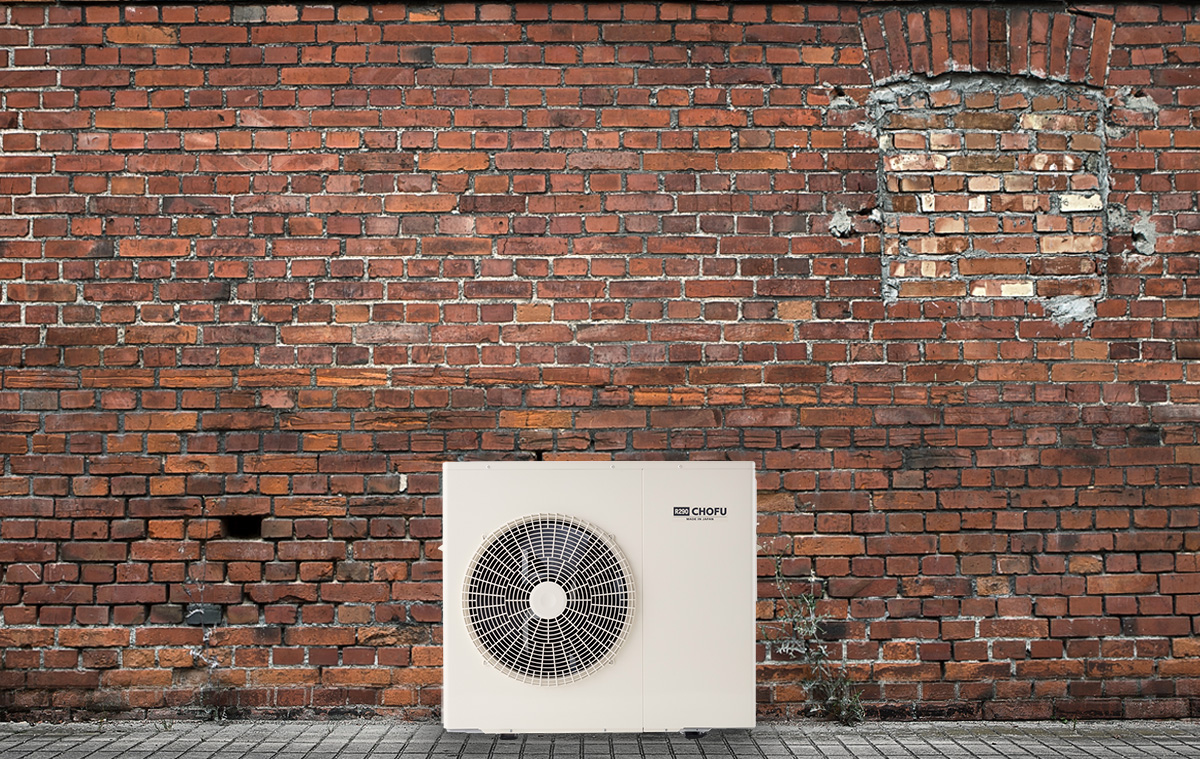
In most houses, yes. An air-to-water heat pump works with your existing radiators if it can heat the water to the temperature they need on cold days, and the Chofu R290 models reach a 75 °C flow temperature, the regime classic radiators were chosen for. The question that really matters is a different one: how low the water temperature can go for the rest of the winter, because that is what sets your electricity bill.
Below is the check we do before every quote, with the numbers behind it, so you can run it yourself at home with a tape measure and the labels on your radiators.
Heat pump with radiators: why the flow temperature matters
The radiators in a house built 20 or 40 years ago were chosen for a gas or wood boiler that sends water at 70–80 °C into the system. For a boiler, that temperature costs almost nothing extra: it burns fuel, and its efficiency changes little between 50 and 80 °C.
For a heat pump, every extra degree on the flow is paid for. The pump moves heat from the outdoor air into the water, and the hotter the water has to be, the harder the compressor works for the same kilowatt delivered. You can see it on the EU energy label, where every heat pump has two seasonal efficiency figures: SCOP at 35 °C, the regime of underfloor heating, and SCOP at 55 °C, the regime of radiators. For the Chofu 10 kW Premium, for example, they are 4.68 and 3.61 (EPREL 2457284). The same pump in the same house gets almost a quarter less heat out of every kilowatt-hour you pay for when it runs on radiators.
So there are two conditions, not one. The pump has to reach the temperature the radiators need on the coldest day. And, to stay cheap to run, it has to spend most of the season at a much lower temperature than that.
The Chofu R290 range heats water up to 75 °C and the R32 range up to 60 °C, according to the manufacturer's documentation. The 75 °C is the highest temperature that can be set. The manufacturer does not publish efficiency figures above 55 °C, so we do not give you consumption figures for that range.
How much a radiator gives at a lower temperature
The output in a radiator catalogue is measured under the European standard EN 442, at 75 °C flow, 65 °C return and 20 °C in the room. With cooler water the radiator gives less, but not proportionally. Output follows a power of the temperature difference between water and room: actual output = rated output × (ΔT ÷ 49.8)n, where ΔT is the logarithmic mean difference between water and air and the exponent n is around 1.3 for steel panel radiators (the EN 442 formula; the Zehnder calculator uses the same exponent). Manufacturers give the exact exponent for each radiator type in their technical catalogues.
Here is the calculation for a radiator rated at 2,000 W at 75/65 °C:
| Flow / return | Mean ΔT | Share of rated output | 2,000 W radiator | How much bigger it must be |
|---|---|---|---|---|
| 75 / 65 °C | 49.8 K | 100% | 2,000 W | × 1.0 |
| 70 / 60 °C | 44.8 K | 87% | 1,740 W | × 1.15 |
| 65 / 55 °C | 39.8 K | 75% | 1,490 W | × 1.34 |
| 60 / 50 °C | 34.8 K | 63% | 1,250 W | × 1.6 |
| 55 / 45 °C | 29.7 K | 51% | 1,020 W | × 2.0 |
| 45 / 40 °C | 22.4 K | 35% | 710 W | × 2.8 |
| 35 / 30 °C | 12.3 K | 16% | 330 W | × 6.1 |
The last column tells you how many times bigger the radiator would have to be to give the same heat as at 75/65. At 55 °C flow, a radiator gives about half its catalogue output. At 35 °C, the underfloor regime, it barely heats at all. That is why radiators and underfloor heating are not compared on efficiency alone: each has its own temperature.
Why old radiators are usually bigger than they need to be
The table above seems to say a heat pump on radiators would always have to run at 75 °C. In practice it does not, for three reasons.
First, the catalogue output is only needed on the coldest day of the year. A house is calculated for the design outdoor temperature, −15 °C in Oradea. At 0 °C outside, the house loses about 57% of the heat it loses at −15 °C, so the radiators can work with much cooler water. The pump adjusts this by itself, following the heating curve set at commissioning: the warmer it is outside, the cooler the water it sends to the radiators.
Second, installers chose radiators with a margin, and the boiler covered everything anyway. Third, many houses have since been insulated and had their windows replaced. The radiators stayed the same but the heat demand went down, so today they are bigger than the house needs.
We call the ratio between the radiators' output at 75/65 and the real heat demand of the house the oversizing factor. The higher it is, the lower the temperature the pump can run at:
| Radiators vs heat demand | −15 °C | −10 °C | −5 °C | 0 °C | +5 °C |
|---|---|---|---|---|---|
| × 1.0 (exactly enough) | 75 °C | 69 °C | 62 °C | 55 °C | 48 °C |
| × 1.3 | 66 °C | 61 °C | 55 °C | 49 °C | 43 °C |
| × 1.6 | 60 °C | 55 °C | 51 °C | 46 °C | 40 °C |
| × 2.0 | 55 °C | 50 °C | 46 °C | 42 °C | 37 °C |
Our own calculation, with the same EN 442 formula, n = 1.3, 20 °C indoors, 10 °C between flow and return at full output, and a heat demand that falls linearly with the outdoor temperature. It ignores sun and the heat given off by people and appliances, which help, so in real life the temperatures come out a little lower. For Cluj or Sibiu, designed for −18 °C, they come out a little higher.
In short: even with radiators sized exactly, the pump needs 75 °C only on the coldest days. And at a factor of 1.6 it never goes above 60 °C, not even at −15 °C, which means a pump from the R32 range would also work in such a house.
How to check whether your radiators are enough
The check is done room by room, not for the whole house. A house can have enough radiators in total and still have a corner room with two outside walls that stays cold.
1. The heat demand of the house and of each room
Start from the heat demand in kilowatts. How it is calculated, and why the 100 watts per square metre rule is often wrong, is in our article on heat pump sizing. For a ballpark figure for the whole house, use the sizing calculator. Then split the demand by room, by floor area and by the number of outside walls. We do the full calculation for free before the quote, and check then whether the radiator surface is enough.
2. Radiator output at 75/65
Many steel panel radiators carry a label with the type (11, 21, 22 or 33, the number of panels and rows of fins) and the dimensions. With the type, height and length you find the output at 75/65 in the manufacturer's catalogue. For radiators without a label, measure height, length and depth and compare with a catalogue. Cast iron and aluminium radiators are rated per section, so count the sections.
3. The ratio and the working temperature
Divide the radiator output in the room by the room's heat demand. The result is the oversizing factor, and the second table shows the flow temperature you need. The room with the lowest ratio sets the temperature for the whole house, because the pump sends the same water to every radiator.
The test with your current boiler
If you have a gas boiler, there is also a practical check. During a cold spell in winter, lower the flow temperature to 55 °C and leave it for a few days. If every room warms up, a heat pump will be able to run on your radiators at 55 °C or less at least on days like those. The colder it is outside when the test passes, the better. If one room stays cold, you know exactly where to act. What else changes when a heat pump replaces the boiler, from the hot water cylinder and the grid connection to the chimney, is covered in a heat pump instead of a gas boiler.
The configurator on this site takes all of this into account. When you pick "Radiators" or "Mixed" as the heating type, it keeps only the models that reach 75 °C, the R290 range, and works out the annual cost with the SCOP at 55 °C, not at 35 °C. If in your house the pump will spend more time below 55 °C, the real cost comes out lower than the one shown.
What to change if a radiator is not enough
You almost never replace all the radiators. Usually there are one or two problem rooms, and there are four options for them:
- A bigger radiator in place of the old one, on the same connections. A type 33 radiator gives much more than a type 22 of the same length and height, so often you need no extra wall space.
- An extra radiator in the room that falls short, on the same riser.
- A fan coil or a fan-assisted radiator. The fan pushes air through the heat exchanger and gets much more heat out of low-temperature water than a plain radiator of the same size. It needs a socket and makes a slight noise, so it suits a living room better than a bedroom.
- Insulation. Anything that lowers the heat demand raises the oversizing factor of every radiator at once: walls, attic, windows. Besides the bill, it also lowers the flow temperature.
Underfloor heating and radiators in the same house
People often ask us which is better, underfloor heating or radiators. On efficiency the answer is simple: underfloor wins, because it runs at around 35 °C. In an existing house, though, underfloor heating means breaking and relaying the screed, which is rarely worth it just for the heat pump. It makes sense where you are renovating anyway: a bathroom, a kitchen, an extension. What underfloor heating designed for a heat pump involves is covered in heat pumps with underfloor heating.
A mixed system, with underfloor heating and radiators, works well with a single pump but on two circuits. The pump makes water at the temperature the radiators need, and the underfloor circuit gets mixed, cooler water through a mixing valve. Seasonal efficiency is then the 55 °C figure, which is also how our configurator calculates the "Mixed" option.
The old system: buffer tank, hydraulic separation and cleaning
Besides the radiators, the pipes and the water in them matter too. Old systems have three typical problems here.
Flow. A heat pump needs a minimum water flow through its heat exchanger. In a house with thermostatic valves, when the rooms reach temperature and the valves close, the flow drops below that minimum. A buffer tank (our catalogue has a 100-litre one) keeps water circulating and cuts down compressor starts and stops.
Hydraulic separation. Many wood or gas systems have their own circulation pumps on several circuits. The buffer tank or a hydraulic separator splits the heat pump circuit from the house circuits, so each circulation pump does its job without getting in the other's way.
Sludge. A steel system that is decades old collects sludge and rust particles. The water heat exchanger in Chofu pumps is stainless steel, and sludge has no business in it. Before connecting, the system should be flushed, and a filter on the return is worth fitting.
On old radiators, the buffer tank, the filter and flushing the system matter as much as the pump. Look for them in any quote you get, not just for the price of the unit.
An example: Vila Veronica, on the radiators of a wood boiler
Vila Veronica, a house in Bihor, was heated by a wood boiler, on classic radiators sized for water at 70 °C. The owners wanted to stop feeding wood every day without redoing the indoor system. Replacing all the radiators would have doubled the cost of the job.
In 2023 a 10 kW R290 unit was installed there. It heats water to 75 °C. The radiators stayed where they were. Only the connection was changed and a buffer tank was added. You will find more jobs, on houses and commercial buildings, under projects.
Which Chofu heat pump for radiators
For radiators we recommend the R290 range, because it has temperature headroom up to 75 °C on the coldest days. Here are the efficiency figures from the energy label, in both regimes:
| Model | Max. flow | SCOP at 35 °C | SCOP at 55 °C |
|---|---|---|---|
| 4 kW Premium | 75 °C | 4.48 | 3.31 |
| 6 kW Premium | 75 °C | 4.46 | 3.43 |
| 10 kW Premium | 75 °C | 4.68 | 3.61 |
| 6 kW Standard | 75 °C | 4.5 | 3.3 |
| 8 kW Standard | 75 °C | 4.5 | 3.5 |
| 12 kW Standard | 75 °C | 4.7 | 3.6 |
| R32 range, 6–16 kW | 60 °C | 4.1–4.8 | 3.2 |
There are also three-phase versions, the 10 kW Premium and the 12 kW Standard, with the same flow temperature. They are not registered in the EU's EPREL database, so we do not list their SCOP. The R32 range works on radiators only if they are big enough never to need more than 60 °C, even on the coldest day, which by the second table means about 1.6 times the heat demand.
Choose the output by the heat demand of the house, not by the radiators. The radiators decide the temperature, the house decides the kilowatts, and an oversized pump cycles on radiators just as it does on underfloor heating. The price of each model is on its page in the catalogue. The quote with installation comes as separate lines: the pump, the hot water cylinder, installation and transport.
Frequently asked questions
Does an air-to-water heat pump work with cast iron radiators?
Yes. The check is the same: the radiators' output at 75/65 °C, which you get by counting sections, compared with the room's heat demand. Cast iron radiators hold a lot of water, which helps the pump run smoothly, but old cast iron systems almost always contain sludge, so flushing and a filter are a must.
Do I have to replace my radiators if I switch to a heat pump?
Usually not. With a model that reaches 75 °C, classic radiators work normally on cold days too. The room-by-room check turns up one or two rooms at most where a bigger radiator is worth it. At Vila Veronica none was replaced.
Does a heat pump use more electricity on radiators than on underfloor heating?
Yes. On the energy label, the SCOP at 55 °C is 22–33% lower than at 35 °C, depending on the model. The bigger the radiators are compared with the heat demand, the lower the pump runs and the smaller the difference.
How much does a heat pump for radiators cost?
The price of each model is on its page in the catalogue. The total depends on what else your system needs: a buffer tank, a hot water cylinder, a filter, perhaps a bigger radiator. That is why we do the sizing first, for free, and only then the quote, with separate lines.
Do I need a buffer tank on a radiator system?
On old systems, most of the time yes: thermostatic valves close the circuit, and the buffer keeps the minimum flow and cuts compressor starts. We decide once we have seen the layout of your system.
Can the pump cope with cold winters on radiators?
Chofu pumps work down to −20 °C outside. On the coldest days they need the highest flow temperature, which is why for radiators we recommend the R290 range, with headroom up to 75 °C.
Next step
Start with the heat demand of your house: in two minutes you find out how many kilowatts you need and which models fit radiators. If you want us to look at your radiators and your system as well, send us a few details about the house and within one working day you get a quote with installation, in separate lines.
Next step
Find the heat pump that fits
Same questions, two minutes, no contact details.
Next steps
If you're clear on the output
Your next step depends on where you've got to: the figure for your house, the models that cover it, or who does the installation.
- Work out your house's heat demand Same questions, two minutes, no contact details.
- See the Chofu models From 4 to 16 kW, with the output and coverage for each.
- Who does the installation Certified Chofu partner installers, vetted by NEDAVI. You choose who does the job.