
Guide
How many kW do you need: sizing a heat pump properly
Floor area alone does not tell you which heat pump you need. Add insulation, storeys and the type of heating and you get the right figure in minutes.
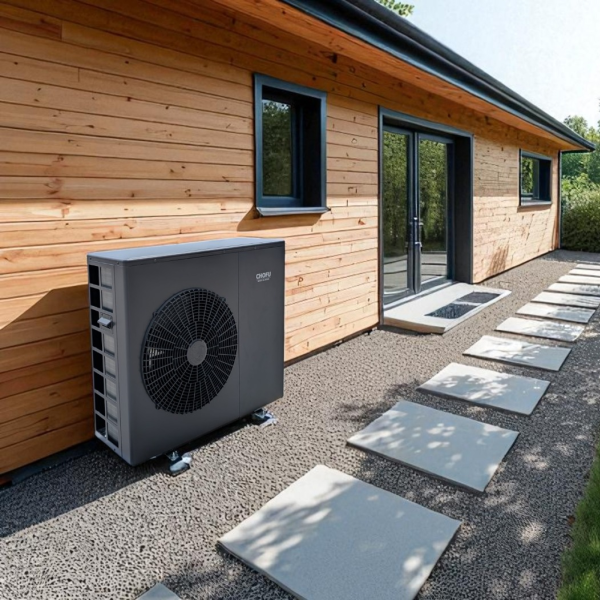
Properly sizing a heat pump starts with the home’s actual heat loss. For an ordinary house with underfloor heating, allow 55 W per square metre if it is well insulated, 75 W if the insulation is average and 100 W if it is poor, then add 0.2 kW for each person using hot water. A 120 m² house with average insulation comes to almost 10 kW; a well insulated 200 m² house to almost 12 kW. Below you will find the full table, a worked example and the things that can move the answer one model up or down.
How many kW do I need: the short answer
A heat pump is sized on the heat demand of the house, that is, how much heat the house loses on the coldest day of winter. Floor area goes into the sum but does not settle it. Two 150 m² houses, one with 10 cm of polystyrene on the walls and one without, differ by a whole model, sometimes two.
So the question "what heat pump do I need for 150 m²" only has a good answer after three more: how well the house is insulated, how many storeys it has, and whether you heat through the floor or through radiators.
Why square metres are not enough
The 100 W per square metre rule has been around for years. For an old, uninsulated house with wooden windows it is close. For a house insulated in the last ten years it gives almost double the output you need. What actually counts:
- Wall insulation, where most of the heat escapes.
- Loft or roof insulation, if the attic is lived in.
- Windows: triple glazing, double glazing, or old frames.
- Ceiling height. At 3.5 m instead of 2.6 m there is 35% more air to heat.
- Number of storeys. A single-storey house loses more through floor and roof per square metre than a two-storey one.
- Hot water, which comes on top of space heating.
- Climate zone. The Romanian methodology Mc 001-2022 splits the country into five zones by design outdoor temperature: −12 °C in Constanța, −15 °C in Bucharest, −18 °C in Cluj-Napoca, −21 °C in Brașov (climate zone map, Mc 001-2022).
The climate zone matters less than people expect. Losses through the walls rise in proportion to the difference between indoor and outdoor temperature. At 20 °C indoors, Bucharest is designed for a 35-degree difference and Cluj for 38. That is about 9% more, much less than ten centimetres of polystyrene makes.
How our sizing tool calculates
On the sizing page we use a simple formula you can check with a pencil:
kW = floor area × W/m² ÷ 1000 × (ceiling height ÷ 2.6 m) × storey factor + people × 0.2 kW
The starting values are 55 W/m² for a well insulated house, 75 W/m² for average insulation and 100 W/m² for poor insulation. The 55 W/m² comes from the coverage we publish on each model: the 8 kW pump for about 140 m², the 10 kW for about 180 m², the 16 kW for about 300 m².
We do not ask you to rate your own insulation, because that is hard to judge. You tell us what the house has and the grade follows:
| Element | Well insulated | Average | Poor | Weight |
|---|---|---|---|---|
| Walls | 10 cm or more | 5–9 cm | under 5 cm | 50% |
| Loft or roof | 15 cm or more | 8–14 cm | under 8 cm | 30% |
| Windows | triple glazing | double glazing | old frames | 20% |
The thicknesses are for EPS polystyrene or stone wool; mineral wool and weaker materials need a little more for the same grade. A single-storey house then gets 10% added, a house with ground floor, first floor and attic 5% taken off.
The tool suggests the smallest model that covers the demand. We accept a pump up to 10% below the calculated figure, because the demand is worked out for the coldest day, which comes a few times a winter. So an 8 kW pump covers a demand of up to 8.9 kW and a 12 kW pump up to 13.3 kW.
Worked example: one 150 m² house, three answers
A 150 m² house on two floors, 2.6 m ceilings, underfloor heating, four people. The loft has 20 cm of mineral wool, the windows are double glazed. Only the walls and the shape of the house change.
| Variant | Grade | Sum | Demand | Model |
|---|---|---|---|---|
| A. Walls with 10 cm EPS | well insulated | 150 × 55 ÷ 1000 + 4 × 0.2 | 9.05 kW | 10 kW |
| B. Uninsulated walls | average | 150 × 75 ÷ 1000 + 0.8 | 12.05 kW | 12 kW |
| C. As B, single storey, 2.8 m ceilings | average | 11.25 × (2.8 ÷ 2.6) × 1.10 + 0.8 | 14.13 kW | 16 kW |
In variant A the 10 kW pump covers 9.05 kW with 10% to spare; for this house the 10 kW model suits anything from 123 to 184 m². In B, bare walls pull the whole house down to "average" even though loft and windows are good, because walls carry the most weight. In C the same floor area on one level with higher ceilings reaches 14.13 kW: a 16 kW model on underfloor heating, or, on radiators, where only the R290 pumps up to 12 kW qualify, two 8 kW units in cascade. For "a 150 square metre house" the answer ran from 10 to 16 kW.
Heat pump for 100, 120, 150 and 200 m²: the table
Same formula, for a two-storey house with 2.6 m ceilings, underfloor heating and four people. First figure is the demand, second is the model the tool suggests.
| Floor area | Well insulated (55 W/m²) | Average (75 W/m²) | Poor (100 W/m²) |
|---|---|---|---|
| 80 m² | 5.2 kW → 6 kW | 6.8 kW → 8 kW | 8.8 kW → 8 kW |
| 100 m² | 6.3 kW → 6 kW | 8.3 kW → 8 kW | 10.8 kW → 10 kW |
| 120 m² | 7.4 kW → 8 kW | 9.8 kW → 10 kW | 12.8 kW → 12 kW |
| 150 m² | 9.1 kW → 10 kW | 12.1 kW → 12 kW | 15.8 kW → 16 kW |
| 180 m² | 10.7 kW → 10 kW | 14.3 kW → 16 kW | 18.8 kW → 2 × 10 kW |
| 200 m² | 11.8 kW → 12 kW | 15.8 kW → 16 kW | 20.8 kW → 2 × 10 kW |
| 250 m² | 14.6 kW → 16 kW | 19.6 kW → 2 × 10 kW | 25.8 kW → 2 × 12 kW |
| 300 m² | 17.3 kW → 16 kW | 23.3 kW → 2 × 12 kW | 30.8 kW → 2 × 16 kW |
The table is an estimate for a typical house. Single storey, high ceilings or radiators change the result. Put your own figures into the sizing tool: it takes two minutes and asks for no contact details.
What 6, 8, 10, 12 or 16 kW means in the Chofu range
Chofu pumps are air-to-water monoblock units with a Panasonic compressor. The output in the name is the model's rated output. The coverage below is what we state on the product pages, for a well insulated house.
| Output | Models | Well insulated house, up to | Max flow |
|---|---|---|---|
| 4 kW | R290 Premium | 70 m² | 75 °C |
| 6 kW | R290 Standard, R290 Premium, R32 | 110 m² | 75 °C (R32: 60 °C) |
| 8 kW | R290 Standard | 140 m² | 75 °C |
| 10 kW | R290 Premium (also three-phase), R32 | 180 m² | 75 °C (R32: 60 °C) |
| 12 kW | R290 Standard (also three-phase), R32 | 220 m² | 75 °C (R32: 60 °C) |
| 16 kW | R32 (also three-phase) | 300 m² | 60 °C |
Each model's price is on its own page, and all of them are on the heat pumps page. If you have a three-phase supply, the 10, 12 and 16 kW outputs also come in three-phase versions; when you need one is explained in the article on the 16 kW three-phase heat pump. Note also that from 1 January 2027 Regulation (EU) 2024/573 bans placing on the market self-contained (monobloc) heat pumps that use fluorinated gases with a GWP of 150 or more, both up to 12 kW and above 12 kW up to 50 kW (EUR-Lex, Annex IV; European Commission). R32 has a GWP of 675, so every Chofu R32 monobloc model is affected (R290 has a GWP of 0.02), but only for new units placed on the market: those already installed stay legal.
Underfloor or radiators: what changes
On underfloor heating the pump works with water at 30–35 °C; radiators need hotter water, and efficiency drops as the flow temperature rises. On the 8 kW R290 Standard, the datasheet gives an SCOP of 4.5 at 35 °C and 3.5 at 55 °C. How to design underfloor heating for a heat pump is covered in heat pumps with underfloor heating.
The house's demand does not change with the emitters, but the list of usable models does. For radiators and mixed systems the tool keeps only the R290 pumps, which reach 75 °C; the R32 units stop at 60 °C and suit underfloor heating or oversized radiators. Since R290 goes up to 12 kW, a radiator house that needs more gets two units joined with a cascade kit. Before quoting we also check that each room's radiators are large enough for cooler water. Sometimes swapping two or three radiators is enough.
Why an oversized pump is a mistake
With a gas boiler a few spare kW did no harm. With a heat pump they do. A pump that is far too big reaches the set temperature quickly, stops and restarts a few minutes later. Every compressor start costs more than steady running and adds wear. A well chosen pump runs long at low speed, which is where it is most efficient. The tool warns you when a model is more than 1.35 times the demand and offers the smaller one. Where many circuits close independently, a 100-litre buffer tank helps the compressor avoid short cycles.
What the pump does at −15 °C outside
An air-to-water pump delivers less output as the outside air gets colder, so we read the datasheet at −7 °C, not just the name. For the R290 Premium models the datasheet gives the rated output at −7 °C too: 10.0 kW for the 10 kW model, with a COP of 2.44. All Chofu pumps operate down to −20 °C outside. On the few coldest hours of the year an electric backup heater, for example the one in the hydrobox, may help. A few days a year is normal; weeks on end means the pump is too small.
The full calculation, before the quote
The sizing tool gives you a sound figure for comparing models and prices. Before quoting we do the full calculation for your house, free of charge. The reference method is SR EN 12831-1, the design heat load standard, with its Romanian national annex (ASRO, SR EN 12831-1:2017/NA:2022): room by room, with your zone's outdoor temperature and the losses through walls, windows, floor and ventilation. Installation is done by a certified installer you choose from the Chofu partner network, vetted by NEDAVI. The warranty is 3 years on the unit and 5 years on the compressor, with commissioning by a qualified person and an annual service.
Frequently asked questions
How many kW do I need for a 100 m² house?
With underfloor heating, two storeys and four people: 6 kW if well insulated, 8 kW with average insulation, 10 kW if poorly insulated. On a single storey the demand is about 10% higher.
What heat pump do I need for 200 m²?
A well insulated 200 m² house needs about 11.8 kW, so a 12 kW pump. With average insulation it reaches 15.8 kW, so 16 kW. Poorly insulated, it passes 20 kW and is solved with two units in cascade.
Does a 10 kW heat pump use 10 kW of electricity?
No. 10 kW is the heat it produces. The 10 kW R290 Premium draws 2.02 kW from the grid at 7 °C outside and 35 °C flow, a COP of 4.95. In colder weather consumption rises.
Is it safer to buy a bigger pump than I need?
No. A heavily oversized pump starts and stops often, uses more power and wears faster. Choose the model that covers the demand, with at most 35% to spare.
Do radiators need a more powerful pump?
The demand is the same, but you need a pump that reaches radiator temperatures. R290 models reach 75 °C, R32 models 60 °C. Efficiency is lower than on underfloor heating, so the bill is somewhat higher.
Does hot water count in the sizing?
Yes, a little: 0.2 kW per person in our calculation, 0.8 kW for a family of four. The cylinder matters more: it needs an enlarged coil made for heat pumps.
Next step
Put your house's figures into the sizing tool to see the exact model and the floor area it covers. For the final figure with installation, send us the details and you will get an itemised quote within one working day.
Next step
Find the heat pump that fits
Same questions, two minutes, no contact details.
Next steps
If you're clear on the output
Your next step depends on where you've got to: the figure for your house, the models that cover it, or who does the installation.
- Work out your house's heat demand Same questions, two minutes, no contact details.
- See the Chofu models From 4 to 16 kW, with the output and coverage for each.
- Who does the installation Certified Chofu partner installers, vetted by NEDAVI. You choose who does the job.