
Guide
12 kW heat pump: which house it suits, what it uses, which models there are
A 12 kW pump covers houses that need between 11.2 and 13.3 kW. See how many square metres that means, which model works with radiators and when 10 or 16 kW is better.
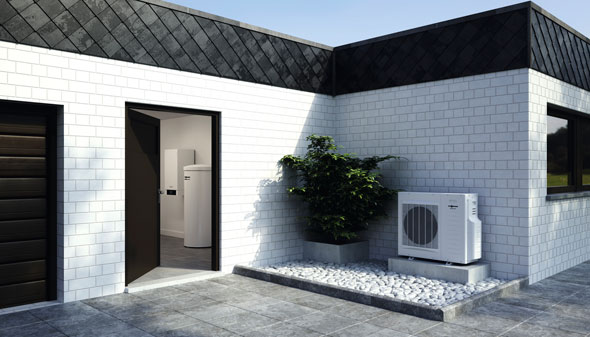
A 12 kW heat pump is enough for a two-storey house of up to about 220 m² if it is well insulated, 160 m² with average insulation or 120 m² if it is poorly insulated. More precisely, it is the right size when the house needs between 11.2 and 13.3 kW. Chofu makes three 12 kW models, all air-to-water monobloc units: R290 Standard on 230 V, R290 Standard three-phase and R32, and the differences between them matter more than you might think.
Which house a 12 kW heat pump is enough for
You size a heat pump by the heat demand of the house, not by square metres. We use the same formula as the sizing page, explained in detail in the article on how to choose the heat pump output:
kW = floor area × W/m² ÷ 1000 × (ceiling height ÷ 2.6 m) × storey factor + occupants × 0.2 kW
The starting values are 55 W/m² for a well insulated house, 75 W/m² for average insulation and 100 W/m² for a poorly insulated one. A single-storey house gets 10% more, a house with ground floor, first floor and attic 5% less. Each occupant adds 0.2 kW for hot water.
The configurator accepts a pump up to 10% below the demand, because the coldest day comes a few times a winter, not all winter. That gives the 12 kW model its range: the 10 kW pump covers up to 11.1 kW, and the 12 kW takes over from there up to 13.3 kW. Below 8.9 kW, 12 kW is more than 35% above what the house needs, and the configurator warns you that it is too big.
| Insulation | Ground floor only | Ground and first floor | Ground, first floor and attic |
|---|---|---|---|
| Well insulated (55 W/m²) | 170–207 m² | 188–227 m² | 197–240 m² |
| Average insulation (75 W/m²) | 125–152 m² | 138–167 m² | 145–176 m² |
| Poorly insulated (100 W/m²) | 94–114 m² | 103–125 m² | 109–132 m² |
Below the range in the table a smaller model is enough; above it you move to 16 kW or to two units in cascade. You do not pick the insulation level by feel: the configurator works it out from the insulation thickness on the walls and in the loft and from the type of windows. A house with 10 cm of polystyrene on the walls, 20 cm in the loft and triple glazing counts as well insulated. The same house with bare walls drops to average insulation.
Example: a 200 m² house, well insulated
Ground and first floor, 2.6 m ceilings, four occupants, good insulation:
200 × 55 ÷ 1000 = 11.0 kW for heating, plus 4 × 0.2 = 0.8 kW for hot water, so 11.8 kW. That is above the 11.1 kW the 10 kW model covers and below the 13.3 kW the 12 kW model reaches. The answer is a 12 kW pump, and the configurator shows that for a house built like this one the model fits anywhere between about 151 and 226 m². If you later close in the attic and heat it, you have headroom. If the same house had uninsulated walls, the demand would jump to 15.8 kW and the answer would be different.
The Chofu 12 kW models side by side
All three share the same casing, 1418 × 1000 × 330 mm, a Panasonic DC twin rotary compressor and the same warranty: 3 years on the unit and 5 years on the compressor. They differ in refrigerant, maximum flow temperature and how they connect to the grid.
| R290 Standard 12 kW | R290 Standard 12 kW three-phase | R32 12 kW | |
|---|---|---|---|
| Power supply | 230 V, single-phase | 380 V, three-phase | 230 V, single-phase |
| Maximum flow temperature | 75 °C | 75 °C | 60 °C |
| COP (A7/W35) | 4.90 | 4.67 | 4.30 |
| SCOP at 35 / 55 °C | 4.7 / 3.6 | not published | 4.7 / 3.2 |
| Energy class 35 / 55 °C | A+++ / A++ | not in EPREL | A+++ / A++ |
| Output at −7 °C (part load) | 9.90 kW, COP 3.00 | not published | 8.61 kW, COP 2.64 |
| Power input (A7/W35) | 2.45 kW | 2.57 kW | 2.79 kW |
| Rated / maximum current | 10.7 / 24.0 A | 3.9 / 8.0 A | 12.2 / 23.0 A |
| Sound power | 59 dB(A) | not published | 62 dB(A) |
| Refrigerant | R290 (propane), 1.15 kg | R290 (propane), 1.15 kg | R32, 2.20 kg |
| Weight | 117 kg | 127 kg | 98 kg |
The −7 °C output on the data sheet comes from the seasonal efficiency test, run at part load. It is not the pump's maximum output at −7 °C, so use it to compare the models with each other, not to hold against the heat demand of your house. All three run down to −20 °C outside.
For the three-phase version we have no energy class, SCOP or noise figure: the model is not registered in EPREL and its data sheet does not give them. We did not fill them in with guesses. The price of each model is on its product page, linked at the top of the table.
12 kW air-to-water heat pump: single-phase or three-phase
At 12 kW, single-phase usually works. The R290 model on 230 V normally draws 10.7 A and at most 24.0 A, roughly 5.5 kVA on one phase, on top of the rest of the house. The R32 model peaks at 23.0 A. The three-phase version spreads the current over three phases: 3.9 A in normal running and at most 8.0 A per phase.
In Romania a single-phase connection is normally granted for up to 11 kVA (ANRE Order no. 102/2015, art. 7, checked on 27.09.2026). If you already have three-phase, choose the three-phase version so the phases stay balanced. If you have single-phase, check the approved capacity on your connection certificate before ordering. The three-phase unit does not use less electricity; its COP is even slightly lower (4.67 against 4.90). Fuses, meters and capacity upgrades are covered in the article single-phase or three-phase heat pump.
Radiators or underfloor: which model is left
This is where the real choice happens. Underfloor heating needs 30–35 °C flow water, and any of the three pumps handles that easily. Classic radiators, sized for a gas boiler, often need water hotter than 60 °C on cold days. That is why the configurator keeps only the R290 range for radiators, since it reaches 75 °C. How to check whether yours work at a lower temperature is explained in the article on heat pumps with old radiators.
- Underfloor: R32 12 kW or R290 Standard 12 kW. SCOP at 35 °C is the same, 4.7.
- Radiators or a mixed system: R290 Standard 12 kW, on 230 V or 380 V. At 55 °C its SCOP is 3.6, against 3.2 for the R32.
- Radiators and a demand above 13.3 kW: 12 kW is the largest R290 pump in the range, so the answer becomes a cascade of two R290 units.
For a new house, plan underfloor heating from the start: it lowers the bill more than any choice between models.
How much electricity a 12 kW heat pump uses
The house decides consumption, not the label. We use the assumptions from the article what a winter with a heat pump costs: climate zone II (−15 °C design temperature: Oradea, Arad, Bucharest), 1,980 equivalent full-load hours a year, heating only, electricity at 1.35 lei/kWh. The example house needs 11.0 kW for heating, so 11.0 × 1,980 = 21,780 kWh of heat a year.
| Model and system | SCOP | Electricity a year | At 1.35 lei/kWh | At 1.11 lei/kWh |
|---|---|---|---|---|
| R290 Standard 12 kW or R32 12 kW, underfloor | 4.7 | 4,634 kWh | 6,256 lei | 5,144 lei |
| R290 Standard 12 kW, radiators at 55 °C | 3.6 | 6,050 kWh | 8,168 lei | 6,716 lei |
| R32 12 kW, radiators at 55 °C | 3.2 | 6,806 kWh | 9,188 lei | 7,555 lei |
These figures are an upper bound, because the method does not subtract sunshine through the windows or heat produced inside the house. The prices of 1.35 and 1.11 lei/kWh are the two tariffs in our calculator, checked on 17.09.2026. There is no published SCOP for the three-phase version, so we did not give it its own row.
Instant draw is a separate question: at +7 °C outside and 35 °C flow, at full output, the 230 V R290 model draws 2.45 kW, the three-phase one 2.57 kW and the R32 2.79 kW. For most of the winter, though, the pump runs at reduced speed.
The R32 12 kW and the 2027 rule
From 1 January 2027, new monobloc heat pumps using fluorinated gases with a GWP of 150 or more can no longer be placed on the EU market, both in the up to 12 kW class and in the 12–50 kW class (Regulation (EU) 2024/573, EUR-Lex). R32 has a GWP of 675; R290 has a GWP of 0.02.
- An R32 pump that is already installed stays legal and can still be run and repaired.
- R32 units placed on the market before 2027 can still be sold afterwards, while stock lasts.
- After that, only the R290 Standard models remain at 12 kW, on 230 V and 380 V.
If you have underfloor heating, the R32 12 kW is still a fair choice, with the same warranty as the rest of the range. If you have radiators, the answer is R290 anyway, and that stays available after 2027. The underlying differences between the two gases are in the article R290 or R32.
Hot water cylinder and installation at 12 kW
For pumps of 9 kW or more, our standard quote includes a 300 litre cylinder with a 4 m² coil, made for the lower flow temperature of a heat pump. Why the cylinder of your old boiler will not do is explained in the article which hot water cylinder you need.
The outdoor unit is 1.42 m tall and weighs 98–127 kg depending on the model, so it needs a solid plinth or a floor stand with anti-vibration mounts, and clear space in front for airflow.
When a 10 kW or 16 kW pump is the better pick
The configurator figure decides, not the wish for "some reserve". A pump that is far too large keeps switching on and off, which raises consumption and wears the compressor.
| Heat demand | Underfloor | Radiators |
|---|---|---|
| 8.9–11.1 kW | 10 kW (R32 or R290 Premium) | 10 kW R290 Premium |
| 11.2–13.3 kW | 12 kW (R32 or R290 Standard) | 12 kW R290 Standard |
| 13.4–17.8 kW | 16 kW R32, single-phase or three-phase | Two R290 units in cascade |
Choose 10 kW when the demand is under 11.1 kW, for example 150 m² well insulated or 130 m² with average insulation. The 10 kW R290 Premium also has the lowest sound power in our tables, 54 dB(A), against 59 dB(A) for the 12 kW Standard. The details are in the article on the 10 kW heat pump.
Choose 16 kW when the demand goes above 13.3 kW: 200 m² with average insulation, 250 m² well insulated or a large single-storey house. At 16 kW the range only has R32 models, and for radiators the configurator suggests a cascade. It is all explained in the article on the 16 kW heat pump.
Frequently asked questions
How many square metres does a 12 kW heat pump heat?
For a two-storey house with four occupants: about 190–225 m² if well insulated, 140–165 m² with average insulation or 105–125 m² if poorly insulated. What counts is the demand: 12 kW covers houses that need between 11.2 and 13.3 kW.
How much electricity does a 12 kW heat pump use a year?
For a well insulated 200 m² house in climate zone II with underfloor heating, about 4,630 kWh a year, roughly 6,250 lei at 1.35 lei/kWh. On radiators at 55 °C with the R290 model, about 6,050 kWh.
Does a 12 kW heat pump work with radiators?
Yes, the R290 Standard models do, since they heat water up to 75 °C. The R32 model reaches 60 °C and suits underfloor heating or oversized radiators best.
Do I need three-phase power for 12 kW?
Usually not. The 230 V version draws at most 24.0 A on one phase. If you already have a three-phase connection, choose the 380 V model, which draws at most 8.0 A per phase.
Can I still buy the R32 12 kW after 2027?
Only from stock placed on the market by 31 December 2026. After that, the R290 Standard models remain at 12 kW. R32 pumps already installed stay legal.
Where can I see the price of the 12 kW pump?
On the product pages: R290 Standard 12 kW, R290 Standard 12 kW three-phase and R32 12 kW. For a price including installation and cylinder, request a quote.
Next step
Enter your house details in the configurator and see whether you really get 12 kW, or 10 or 16. If you want the final figure, tell us what you have in the rooms, radiators or underfloor, and what grid connection you have. We do the full calculation and send you an itemised quote.
Next step
Find the heat pump that fits
Same questions, two minutes, no contact details.
Next steps
If you're clear on the output
Your next step depends on where you've got to: the figure for your house, the models that cover it, or who does the installation.
- Work out your house's heat demand Same questions, two minutes, no contact details.
- See the Chofu models From 4 to 16 kW, with the output and coverage for each.
- Who does the installation Certified Chofu partner installers, vetted by NEDAVI. You choose who does the job.