
Guide
10 kW heat pump: which house it suits and which model to choose
On two storeys, 10 kW means roughly 150–185 m² of well insulated house. The difference between the two Chofu models shows at −7 °C and on radiators.
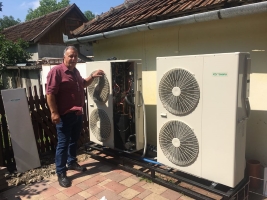
By the formula in our configurator, a 10 kW heat pump suits a two-storey house of roughly 150–185 m² if it is well insulated, 110–135 m² with average insulation and 80–100 m² if the insulation is poor. Chofu makes two genuinely different 10 kW units: the R290 Premium, which heats water to 75 °C and still gives 10.0 kW at −7 °C, and the R32, which costs less but stops at 60 °C flow. Below are the sums, the two data sheets side by side and the signs that you actually need 8 or 12 kW.
What size house a 10 kW heat pump is right for
A heat pump is sized on how much heat the house loses on the coldest day, not on floor area alone. On the sizing page we use the same formula we explain in how to size a heat pump:
kW = floor area × W/m² ÷ 1000 × (ceiling height ÷ 2.6 m) × storey factor + people × 0.2 kW
The values are 55 W/m² for a well insulated house, 75 W/m² for average insulation and 100 W/m² for a poorly insulated one. The storey factor is 1.10 for a single-storey house, 1.00 for two storeys and 0.95 with a lived-in attic on top. The configurator allows the pump to be up to 10% below the calculated demand, because the design day only comes a few times a winter. So the 10 kW model covers a demand of up to 11.1 kW. If the demand is under 8.9 kW, the configurator suggests the 8 kW pump, which covers it too.
| Insulation | Single storey | Two storeys | Two storeys and attic |
|---|---|---|---|
| Well insulated (55 W/m²) | 134–170 m² | 147–187 m² | 155–197 m² |
| Average insulation (75 W/m²) | 98–125 m² | 108–137 m² | 114–145 m² |
| Poorly insulated (100 W/m²) | 74–94 m² | 81–103 m² | 85–108 m² |
On the product pages we say the 10 kW model covers a well insulated house of 140 to 180 square metres. The table also shows how far insulation and the shape of the house move that figure. An old 100 m² house with bare walls and wooden windows needs 10 kW as well.
Worked example: a 160 m² house with radiators
Take a 160 m² house on two storeys, 2.6 m ceilings, 10 cm of polystyrene on the walls, 20 cm of wool in the loft and double glazing. The configurator rates it "well insulated". Four people live there, and the rooms still have the radiators from the old boiler.
- Space heating: 160 × 55 ÷ 1000 = 8.8 kW.
- Hot water: 4 × 0.2 = 0.8 kW. Total demand: 9.6 kW.
- The 8 kW pump covers at most 8.9 kW, so it falls short.
- The 10 kW pump gives 10 ÷ 9.6 = 1.04 times the demand, a 4% margin. The oversizing limit is 1.35, so we are nowhere near it.
- For this house, the 10 kW model stays right between 123 and 185 m².
With radiators, the configurator keeps only the R290 models, which heat water to 75 °C. The answer is the Chofu 10 kW Premium. With underfloor heating, the R32 would also be an option.
Chofu 10 kW air-to-water heat pumps side by side
Every Chofu heat pump is an air-to-water monobloc: only water comes into the house. There are three 10 kW products in the catalogue, of which two are technically different: the R290 Premium, single-phase and three-phase, and the R32, single-phase only. The figures below come from the Chofu data sheets, the EU EPREL database and the Heat Pump KEYMARK certificate of the R290 model.
| Specification | R290 Premium 10 kW | R32 10 kW |
|---|---|---|
| Model code | AEYC-1049ZU-CH1 | AEYC-1043XU-CH |
| Refrigerant | R290 (propane), GWP 0.02, 1.15 kg | R32, GWP 675, 1.55 kg |
| Maximum flow temperature | 75 °C | 60 °C |
| SCOP at 35 °C / 55 °C | 4.68 / 3.61 (KEYMARK) | 4.8 / 3.2 (Chofu data sheet) |
| Energy class 35 °C / 55 °C | A+++ / A++ | A+++ / A++ |
| At +7 °C outside, 35 °C flow | 10.0 kW heat, 2.02 kW power input, COP 4.95 | 2.28 kW power input, COP 4.39 |
| At −7 °C, part load (EN 14825) | 9.68 kW, COP 2.96 | 6.88 kW, COP 2.72 |
| At −7 °C, full output | 10.0 kW (35 °C flow, COP 2.44; 55 °C flow, COP 1.93) | not published |
| Running current | 8.8 A (max. 24.0 A) | 10.1 A (max. 17.5 A) |
| Sound power | 54 dB(A) | 64 dB(A) |
| Dimensions (H × W × D) | 1418 × 1000 × 330 mm | 882 × 850 × 330 mm |
| Weight | 117 kg | 69 kg |
Both run down to −20 °C outside and carry the same warranty: 3 years on the unit and 5 years on the compressor. Each price is on the model's own page: R290 Premium 10 kW and R32 10 kW.
What each model gives at −7 °C
This is the biggest difference between the two, and the name does not show it. On its model page Chofu gives the R290 Premium 10.0 kW at −7 °C outside, with water at 35 °C and at 55 °C alike (checked on chofuglobal.com, 27.09.2026). Chofu calls it "Premium for cold climate", and the figures back that up: the rated output holds in the cold.
For the R32, Chofu does not publish the full output at −7 °C. There is only one comparable figure, from the European EN 14825 test at part load: 6.88 kW for the R32 and 9.68 kW for the R290 Premium, in the same test. In that test the output at −7 °C follows the design capacity the manufacturer declares, so the R32 10 kW was declared for a smaller house than the R290 Premium 10 kW. For a house near the top of the range, 170–185 m² and well insulated, the Premium is the safer choice. For a 150 m² house with underfloor heating, the R32 copes without trouble.
Single-phase or three-phase
The R290 Premium 10 kW also comes in a three-phase version, drawing 3.2 A per phase (8.0 A maximum) instead of 8.8 A. For it, the Chofu data sheet gives COP 4.72 at +7 °C, but the SCOP, energy class and output at −7 °C have not been published yet, so we leave them out of the table. If you have a three-phase supply and want to know whether it is worth it, the differences are in our article on single-phase or three-phase heat pumps.
A 10 kW heat pump with radiators or underfloor heating
The heat demand of the house is the same whatever you have in the rooms. What changes is the water temperature and, with it, efficiency. With underfloor heating the pump works with water at 30–35 °C, and here both models do very well: SCOP 4.68 for the R290 Premium, 4.8 for the R32. The R32 data sheet says it plainly: it works most efficiently with underfloor heating or oversized radiators.
Radiators are another matter. A standard radiator was chosen for water at 70–75 °C, and at 55 °C it gives about half its catalogue output. The R290 Premium goes up to 75 °C and keeps 10.0 kW at −7 °C even with water at 55 °C. The R32 stops at 60 °C, and at 55 °C its SCOP is 3.2 against 3.61. That is why our configurator, for radiators and mixed systems, no longer suggests the R32 models at all. The room-by-room check, with the radiator formula, is in heat pumps with old radiators.
One example from our projects: at Vila Veronica, in Bihor, a 10 kW R290 unit was fitted in 2023 to replace a wood-fired boiler. The radiators, sized for water at 70 °C, stayed where they were. Only the connection was changed and a buffer tank was added.
How much electricity a 10 kW heat pump uses
A 10 kW heat pump does not use 10 kW. Ten kilowatts is the heat it delivers. From the grid, the R290 Premium draws 2.02 kW at +7 °C outside and 35 °C flow. At −7 °C, with water at 35 °C, it still gives 10 kW at a COP of 2.44, so it draws about 4.1 kW. On radiators at 55 °C and −7 °C outside, the COP is 1.93, so about 5.2 kW. Those are the hardest hours of the year, not the average.
Over a year, the house decides the consumption. We work it out as in what a winter with a heat pump costs: heating output × 1,980 equivalent hours (climate zone II: Oradea, Arad, Bucharest) ÷ SCOP × electricity price. For the 160 m² house in the example, space heating needs 8.8 kW, that is 17,424 kWh of heat a year, hot water excluded.
| Model and system | SCOP | Electricity a year | At 1.11 lei/kWh | At 1.35 lei/kWh |
|---|---|---|---|---|
| R290 Premium, underfloor 35 °C | 4.68 | 3,723 kWh | 4,133 lei | 5,026 lei |
| R32, underfloor 35 °C | 4.8 | 3,630 kWh | 4,029 lei | 4,900 lei |
| R290 Premium, radiators 55 °C | 3.61 | 4,827 kWh | 5,358 lei | 6,516 lei |
The electricity prices are the ones in our calculator, VAT included: 1.11 lei/kWh (Hidroelectrica Viitor Hidro, Muntenia, 01.07–30.09.2026) and 1.35 lei/kWh (PPC Fix Online, September 2026). The figures are an upper bound: the method does not subtract sunshine through the windows or the heat people and appliances give off. On underfloor heating, the gap between R290 and R32 is about 100 lei a year, next to nothing. The big gap is between underfloor and radiators: 30% more electricity for the same heat.
The R32 10 kW and 2027
From 1 January 2027, Regulation (EU) 2024/573 bans placing on the market new monobloc heat pumps that use fluorinated gases with a GWP of 150 or more, both up to 12 kW and from 12 to 50 kW (EUR-Lex, Annex IV). R32 has a GWP of 675, so the rule covers the Chofu R32 10 kW. In practice:
- an R32 heat pump already installed stays legal and can be serviced and repaired;
- units placed on the market before 2027 can still be sold from stock;
- R290 has a GWP of 0.02 and is not affected by this ban.
For a house with underfloor heating, the R32 is still a sound choice if price matters; just do not put the decision off. The whole story, with the table of deadlines, is in R290 vs R32: the real difference.
When 8 kW or 12 kW is the better pick
An oversized pump starts and stops often and wears its compressor; an undersized one leaves the backup heater running for weeks. The configurator's rule: the smallest model that covers the demand, without going over 1.35 times the demand.
| Demand (heating + hot water) | Suggested model | Example, two storeys, 4 people |
|---|---|---|
| up to 8.9 kW | 8 kW R290 Standard | 140 m² well insulated: 8.5 kW |
| 8.9–11.1 kW | 10 kW, R290 Premium or R32 | 160 m² well insulated: 9.6 kW |
| 11.1–13.3 kW | 12 kW R290 Standard or R32 | 200 m² well insulated: 11.8 kW; 150 m² average insulation: 12.05 kW |
Pick 8 kW if the demand comes out under 8.9 kW. A well insulated 140 m² house needs 8.5 kW, and a 10 kW pump would be 18% over. You would be paying for output you never use.
Pick 12 kW if the demand goes over 11.1 kW: 200 m² well insulated, 150 m² with average insulation, or a 180 m² single-storey house. On radiators, R290 goes up to 12 kW. Above that, the configurator suggests two units in cascade. The details are in our article on the 12 kW heat pump.
If you plan to insulate the house, size for the insulated house. A 150 m² house going from average insulation to well insulated drops from 12 to 10 kW.
How much a 10 kW heat pump costs
The price of each unit is on its own page, and all of them are on the heat pumps page. The final sum also includes a hot water cylinder with an enlarged coil, sometimes a buffer tank, materials and installation, which depend on the house: the distance to the plant room and the system you already have. For an exact figure, send us the details of the house and you get an itemised quote.
Frequently asked questions
How many square metres does a 10 kW heat pump heat?
On two storeys, with four people: about 147–187 m² if well insulated, 108–137 m² with average insulation and 81–103 m² if poorly insulated. On a single storey the ranges drop by about 10%.
How much power does a 10 kW heat pump draw per hour?
The R290 Premium draws 2.02 kW at +7 °C outside and 35 °C flow. At −7 °C, on underfloor heating, about 4.1 kW; on radiators at 55 °C, about 5.2 kW. Over a year, a well insulated 160 m² house uses about 3,700 kWh on underfloor heating.
Does a 10 kW heat pump work with radiators?
The R290 Premium does: it heats water to 75 °C and gives 10.0 kW at −7 °C even with water at 55 °C. The R32 stops at 60 °C and is meant for underfloor heating or oversized radiators.
R290 Premium or R32 at 10 kW?
With radiators, the R290 Premium. With underfloor heating both work, with almost equal running costs. The R32 is cheaper but gives less at −7 °C, and from 2027 new monobloc R32 units can no longer be placed on the EU market.
Do I need a three-phase supply for 10 kW?
No. The single-phase R290 Premium draws 8.8 A at +7 °C, 24.0 A at most. The three-phase version is for homes that already have a three-phase supply.
Check whether 10 kW is right for your house
Enter the floor area, insulation, storeys and heat emitters in the configurator. In two minutes you see whether you need 8, 10 or 12 kW and what a winter will cost. If you want the final figure with installation straight away, send us the details of the house.
Next step
Find the heat pump that fits
Same questions, two minutes, no contact details.
Next steps
If you're clear on the output
Your next step depends on where you've got to: the figure for your house, the models that cover it, or who does the installation.
- Work out your house's heat demand Same questions, two minutes, no contact details.
- See the Chofu models From 4 to 16 kW, with the output and coverage for each.
- Who does the installation Certified Chofu partner installers, vetted by NEDAVI. You choose who does the job.