
Guide
6 kW heat pump: how many square metres it heats and how much it uses
A 6 kW heat pump suits a well insulated house of 70–110 m², not any house "up to 120 m²". Here are the calculation, the models and the consumption.
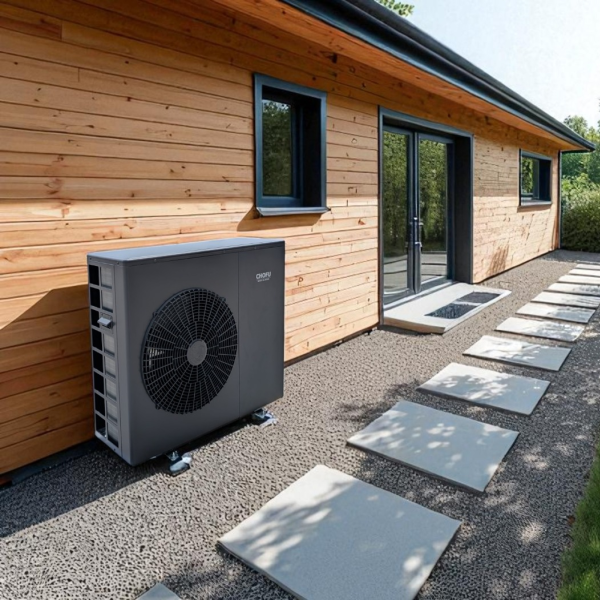
A 6 kW heat pump heats a well insulated house of about 70–110 m² on two floors, with three people living in it. With average insulation that drops to 50–80 m², and in a poorly insulated house to 40–60 m². Over a winter, a well insulated 100 m² house with underfloor heating uses about 2,300–2,450 kWh of electricity with it. Below you will find the calculation, the three Chofu 6 kW models side by side and the signs that you actually need 4 or 8 kW.
How many square metres a 6 kW heat pump heats
Many sites simply say "up to 120 m²". That figure only holds for a very well insulated house. The same 6 kW unit can be too small for an old 80 m² house and too big for a new 60 m² one.
On our sizing page we work out the heat demand with a formula you can check with a pencil:
kW = floor area × W/m² ÷ 1000 × (ceiling height ÷ 2.6 m) × storey factor + people × 0.2 kW
The starting values are 55 W/m² for a well insulated house, 75 W/m² for average insulation and 100 W/m² for a poorly insulated one. A single-storey house gets 10% extra, because it loses more heat through the floor and roof. The 0.2 kW per person covers hot water.
Two limits decide whether 6 kW is the right answer. The configurator accepts a unit up to 10% below the demand, because the demand is worked out for the coldest day of the winter. So 6 kW covers a demand of up to 6.67 kW. It also warns you when the unit is more than 1.35 times the demand, because an oversized heat pump keeps switching on and off. So below a demand of 4.44 kW, 6 kW is already too much. Here is what those two numbers mean in floor area:
| Insulation | Ground floor and upper floor | Ground floor only |
|---|---|---|
| Well insulated (55 W/m²) | 70–110 m² | 64–100 m² |
| Average insulation (75 W/m²) | 51–81 m² | 47–74 m² |
| Poorly insulated (100 W/m²) | 38–61 m² | 35–55 m² |
Below the lower end of the range, a 6 kW unit is oversized. Above the upper end, it is too small. In the well insulated house, four people instead of three move both ends down by 3–4 m², and two people move them up by the same amount. In the configurator, the insulation grade comes from the thickness on the walls and in the loft and from the type of windows. The full method is in our article on how many kW you need.
Worked example: a 100 m² single-storey house
Take a 100 m² house on one level, with 2.6 m ceilings, 12 cm of polystyrene on the walls, 20 cm of mineral wool in the loft, triple glazing and underfloor heating. Three people live in it.
- Walls, loft and windows all come out as "well insulated", so 55 W/m².
- 100 × 55 ÷ 1000 = 5.5 kW.
- Ground floor only: 5.5 × 1.10 = 6.05 kW.
- Hot water: 3 × 0.2 = 0.6 kW. The total demand is 6.65 kW.
- The 6 kW unit covers up to 6.67 kW, so it passes. Only just, but it passes.
Now the same house with one more person: the demand rises to 6.85 kW, beyond what 6 kW covers, and the configurator suggests 8 kW. The 8 kW unit is 1.17 times the demand, so it is not oversized. This is why, at the edge of the range, we don't decide from a table. Before the quote we do the full room-by-room calculation, and only then do we know whether it stays at 6 kW.
A real case: the 110 m² timber-frame house
In a new timber-frame house in Bihor, 110 m², well insulated, with underfloor heating throughout, a 6 kW heat pump was installed in 2023. The owners didn't want a gas connection. The risk in a house like this was not a unit that is too small but one that is too big: the demand is low, and an 8 or 10 kW model "just in case" would have been starting and stopping all day. The underfloor system runs at a low temperature, which is exactly where a heat pump is most efficient.
The three Chofu 6 kW air-to-water heat pumps, side by side
All three are monobloc air-to-water units with a Panasonic compressor, a single-phase 230 V supply and operation down to −20 °C outside. Monobloc means the whole refrigerant circuit stays in the outdoor unit and only water pipes come into the house. What differs is the refrigerant, the maximum flow temperature, the noise and the output in cold weather. The figures come from the Chofu data sheets; we checked the energy class and noise in the EU's EPREL database on 27.09.2026 (Premium, Standard, R32).
| R290 Premium 6 kW | R290 Standard 6 kW | R32 6 kW | |
|---|---|---|---|
| Refrigerant | R290 (propane) | R290 (propane) | R32 |
| Maximum flow temperature | 75 °C | 75 °C | 60 °C |
| COP (A7/W35) | 4.88 | 4.58 | 4.20 |
| SCOP at 35 °C / 55 °C | 4.46 / 3.43 | 4.5 / 3.3 | 4.7 / 3.2 |
| Output at −7 °C | 6.0 kW, full load | 4.71 kW, part load | 3.86 kW, part load |
| Energy class 35 / 55 °C | A+++ / A++ | A+++ / A++ | A+++ / A++ |
| Sound power | 54 dB(A) | 56 dB(A) | 60 dB(A) |
| Running current | 5.3 A (max. 16.6 A) | 5.7 A (max. 12.0 A) | 6.3 A (max. 11.2 A) |
| Dimensions (H × W × D) | 886 × 1000 × 330 mm | 886 × 1000 × 330 mm | 675 × 825 × 300 mm |
| Weight | 82 kg | 66 kg | 50 kg |
The −7 °C row needs a word of explanation, because the figures are not measured the same way. For the Premium, Chofu states the full-load output with −7 °C air and 35 °C water: 6.0 kW, the whole rated output. For the Standard and the R32, the only published figure is the part-load test point from the product fiche (EN 14825), which shows what the unit delivers at that test point, not its maximum. You can compare them as an order of magnitude, not to the decimal.
R290 Premium 6 kW: for cold areas, radiators and close neighbours
The Premium is the most complete of the three: the quietest, with its full output kept at −7 °C and the best SCOP at 55 °C, which is what counts on radiators. It is the pick for a house at the top of the range, for the colder parts of the country, or for a small plot where the unit ends up close to a neighbour's window. It is also the heaviest at 82 kg, so during the site visit we check whether the wall can carry it or whether it goes on the ground, on a stand.
R290 Standard 6 kW: the usual pick for a new house
The Standard has the same refrigerant, the same 75 °C maximum and almost the same underfloor SCOP as the Premium, but it is a little louder and weaker in hard frost. For a well insulated house with underfloor heating, in the middle of the range in the table, it is the model we suggest most often.
R32 6 kW: compact, good on underfloor heating, and the 2027 note
The R32 is the smallest and lightest at 50 kg, so it is the easiest to put on a wall. On underfloor heating it even has the highest SCOP of the three, 4.7 at 35 °C. But it stops at 60 °C flow, so we don't suggest it for conventional radiators. It is also the loudest, at 60 dB(A).
From 1 January 2027, new monobloc heat pumps using fluorinated gases with a GWP of 150 or more can no longer be placed on the EU market (Regulation (EU) 2024/573, Annex IV). R32 has a GWP of 675, so the rule covers every Chofu R32 model. Units already installed stay legal and can be repaired, and units placed on the market before that date can still be sold while stock lasts. The details are in our article R290 or R32.
The price order is the one you would expect: R32, then Standard, then Premium. Each model's price, VAT included, is on its product page, linked from the table above.
A 6 kW heat pump on underfloor heating or on radiators
The heat demand of the house doesn't depend on what you have in the rooms. What changes is the water temperature the heat pump works with, and with it the efficiency and the list of suitable models.
With underfloor heating, the water goes into the loops at 30–35 °C. All three models do well here, with a SCOP between 4.46 and 4.7. In 6 kW houses, which are usually new or fully renovated, underfloor heating is the most common case.
On radiators, the configurator only keeps the R290 models, which heat water up to 75 °C. The R32 stops at 60 °C, which leaves too little headroom on cold days. The bigger question is whether the radiators are large enough. At 55/45 °C a radiator gives about half the output printed in its catalogue, which is measured at 75/65 °C. For a house that needs 5.5 kW for heating, the catalogue outputs of all radiators should therefore add up to around 11 kW for the heat pump to run at 55 °C. Old radiators are often bigger than they need to be, and the room-by-room check is explained in our article on heat pumps with old radiators. If they fall short, you replace two or three radiators, not the heat pump.
How much electricity a 6 kW heat pump uses
There are two answers. The first is the instant draw when the unit is giving its full output. At +7 °C outside and 35 °C flow, the Premium draws 1.23 kW from the grid, the Standard 1.31 kW and the R32 1.43 kW. So a 6 kW heat pump does not use 6 kW. It uses about one kilowatt of electricity for four to five kilowatts of heat.
The second is the yearly consumption, and that is decided by the house. We work it out as in our article on what a winter with a heat pump costs: heating demand × 1,980 equivalent full-load hours a year (Eurostat degree days for climate zone II, −15 °C, which covers Oradea, Arad and Bucharest) ÷ SCOP × electricity price. For a well insulated 100 m² house on two floors: 100 × 55 ÷ 1000 = 5.5 kW, and 5.5 × 1,980 = 10,890 kWh of heat a year. Heating only, without hot water.
| Model | Underfloor, 35 °C | Radiators, 55 °C |
|---|---|---|
| R290 Premium 6 kW | 2,442 kWh 3,296 lei at 1.35 2,710 lei at 1.11 | 3,175 kWh 4,286 lei at 1.35 3,524 lei at 1.11 |
| R290 Standard 6 kW | 2,420 kWh 3,267 lei at 1.35 2,686 lei at 1.11 | 3,300 kWh 4,455 lei at 1.35 3,663 lei at 1.11 |
| R32 6 kW | 2,317 kWh 3,128 lei at 1.35 2,572 lei at 1.11 | not suggested for radiators |
The electricity prices are the ones in our calculator, VAT included: 1.35 lei/kWh (PPC Fix Online, September 2026) and 1.11 lei/kWh (Hidroelectrica Viitor Hidro, Muntenia, 01.07–30.09.2026). On underfloor heating, the three models differ by about 170 lei a year. Between underfloor heating and radiators the gap is 1,000–1,200 lei, so the heating system in the house matters more than the model you pick.
These figures are an upper bound: the degree-day method doesn't subtract sunshine through the windows or the heat given off by people and appliances. In climate zone III (Cluj, Sibiu, Iași, −18 °C) the house needs somewhat more heat per year, so consumption goes up.
6 kW heat pump: price and what else goes into the quote
The unit is only part of the job. In one of our quotes with installation, every heat pump also comes with the hydraulic connection kit (valves, magnetic filter, flexible connectors), the expansion vessel, the controller with room thermostat and the commissioning. For hot water with a 6 kW unit the quote includes a 200-litre cylinder with an enlarged coil, made for heat pumps. Why the old cylinder won't do is explained in our article on the right hot water cylinder. Then comes transport and, where needed, a buffer tank, longer pipework if the unit sits more than 15 m from the plant room, or a dedicated circuit in the fuse box.
Model prices are on their product pages, and every output is on the heat pumps page. The warranty is 3 years on the unit and 5 years on the compressor.
When a 4 kW or an 8 kW heat pump is the better pick
Pick 4 kW if the house needs less than 4.44 kW, the point below which 6 kW becomes oversized. For a well insulated two-storey house that means roughly under 70 m²: a passive house, a small new build, a loft heated on its own. The only Chofu 4 kW model is the R290 Premium 4 kW, with 4.0 kW at −7 °C full load and 54 dB(A).
Pick 8 kW if the demand goes above 6.67 kW. That happens more often than you might think: a 100 m² single-storey house with four people, any house with average insulation above 80 m², ceilings higher than 2.6 m. The model is the R290 Standard 8 kW, with 6.16 kW at −7 °C part load and 57 dB(A).
Two things can push you one model up. The climate zone: the W/m² figures are not adjusted by zone, and in Cluj you design for −18 °C instead of −15 °C, roughly 9% more output. A house at the top of the 6 kW range may need 8 kW there. And your plans: if you will convert the loft in two years, size for the house you will have then. The reverse doesn't work. A bigger model "just in case" means short cycling and money spent on output you never use.
Frequently asked questions
How many square metres does a 6 kW heat pump heat?
About 70–110 m² in a well insulated two-storey house, 51–81 m² with average insulation and 38–61 m² in a poorly insulated house, with 2.6 m ceilings and three people. On a single storey, the ranges shrink by almost 10%.
How much electricity does a 6 kW heat pump use in a year?
In a well insulated 100 m² house with underfloor heating, in climate zone II: 2,300–2,450 kWh a year for heating, or 3,100–3,300 lei at 1.35 lei/kWh. On radiators at 55 °C, 3,175–3,300 kWh.
Does a 6 kW heat pump work with radiators?
Yes, with an R290 model, which heats water up to 75 °C, and with radiators large enough for each room. Consumption is 30–36% higher than on underfloor heating. The 6 kW R32, with 60 °C flow, is made for underfloor heating.
What does a 6 kW monobloc heat pump mean?
The whole refrigerant circuit stays in the outdoor unit. Only water pipes come into the house, so the installation needs no work on the refrigerant circuit. All Chofu heat pumps are monobloc.
Does a 6 kW R32 still make sense before 2027?
Yes, for underfloor heating. The 2027 ban covers placing new units on the market, not installed ones: the heat pump stays legal and can still be repaired. On radiators or in a cold area, R290 is the better choice.
Which hot water cylinder goes with a 6 kW heat pump?
A 200-litre cylinder with an enlarged coil, made for heat pumps. A standard one, made for a gas boiler, has a coil too small for the 50–55 °C water a heat pump works with.
Next step
Enter your house details in the configurator and see whether you land on 4, 6 or 8 kW, with the floor area range for your house. If you want the final figure with installation, send us the details and you will get an itemised quote within one working day.
Next step
Find the heat pump that fits
Same questions, two minutes, no contact details.
Next steps
If you're clear on the output
Your next step depends on where you've got to: the figure for your house, the models that cover it, or who does the installation.
- Work out your house's heat demand Same questions, two minutes, no contact details.
- See the Chofu models From 4 to 16 kW, with the output and coverage for each.
- Who does the installation Certified Chofu partner installers, vetted by NEDAVI. You choose who does the job.