
Technical
How an air-to-water heat pump works and what is inside it
A heat pump burns nothing: it moves heat from the outdoor air into your heating water. Here is the cycle step by step, with the figures from Chofu datasheets, and what happens when it freezes outside.
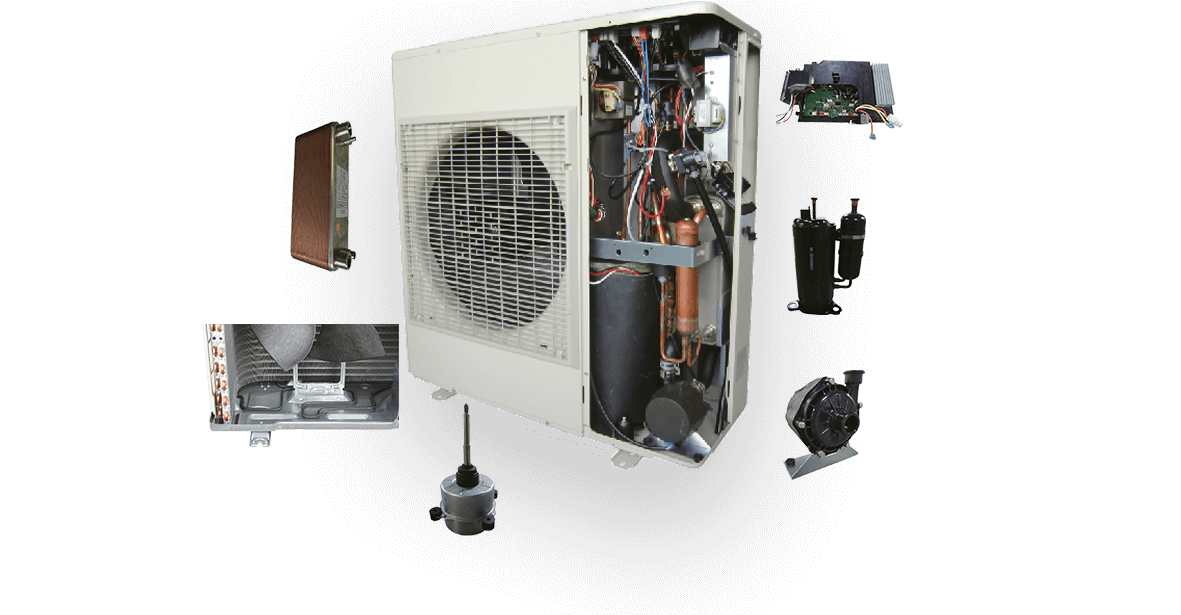
An air-to-water heat pump takes heat from the outdoor air, raises it to a higher temperature with a compressor and hands it to the water in your underfloor heating, radiators and hot water cylinder. The electricity you pay for is not turned into heat directly: it drives the compressor, the fan and the water pump. That is why 1 kWh of electricity gives you 3 to 5 kWh of heat. On Chofu heat pumps, the datasheet COP is between 4.20 and 4.95 at 7 °C outside and 35 °C flow. Below you will find the cycle step by step, what is inside the unit, what it does in winter down to −20 °C and which common beliefs about it are wrong.
What an air-to-water heat pump is
The name tells you where the heat comes from and where it goes: from the outdoor air into the water of the heating system and the hot water cylinder. Between the two sits a sealed circuit filled with refrigerant, R290 (propane) or R32 on Chofu models. The principle is the one of a fridge, used the other way round. A fridge pulls heat out of its interior and dumps it through the grille at the back. A heat pump pulls it out of the outdoor air and gives it to the water. Air at −10 °C feels cold to us, but it still holds a lot of heat, and the refrigerant in the heat pump is colder still, so it can pick that heat up.
How an air-to-water heat pump works: the cycle in four stages
The refrigerant loops endlessly through four components. The trick is that its boiling point depends on pressure. At low pressure it boils below the outdoor air temperature, so it absorbs heat from the air. At high pressure it condenses above the temperature of the heating water, so it releases heat into that water. The compressor and the expansion valve move the refrigerant between the two pressures (Wikipedia, Heat pump, vapour-compression cycle, checked on 27 September 2026).
| Stage | Component | Refrigerant in | What happens | Refrigerant out |
|---|---|---|---|---|
| 1 | Evaporator (the finned coil behind the fan) | cold liquid, low pressure | The fan pushes outdoor air through the fins. The refrigerant, colder than the air, absorbs heat and boils. | cold vapour, low pressure |
| 2 | Compressor | cold vapour, low pressure | The vapour is compressed. Pressure and temperature rise sharply. Most of the electricity is used here. | hot vapour, high pressure |
| 3 | Condenser (the plate heat exchanger, refrigerant on one side, water on the other) | hot vapour, high pressure | The refrigerant gives its heat to the heating water and condenses. | warm liquid, high pressure |
| 4 | Expansion valve | warm liquid, high pressure | Pressure drops suddenly, and temperature drops with it. | cold liquid, low pressure, back to stage 1 |
The diagram in words: outdoor air → evaporator → compressor → condenser → the house water, then the refrigerant returns through the expansion valve to the evaporator. Water and refrigerant never mix; they only touch through the stainless steel plates of the heat exchanger.
Chofu's datasheet lists the type as "DC Inverter (Reverse cycle)": the cycle can be reversed with a four-way valve. That is how the unit cools in summer, and how it defrosts in winter.
Why it gives 3–5 kWh of heat for 1 kWh of electricity
The heat that reaches the water is the sum of two things: the heat taken from the air in the evaporator and the electrical energy used by the compressor, which also ends up as heat. The part from the air is free, and it is the larger one. The ratio between heat delivered and electricity used is called COP.
COP is measured at a fixed test point written as letters and numbers: A7/W35 means 7 °C outdoor air and 35 °C flow water. SCOP is the average over a whole season, cold days and mild ones, calculated for an average European climate. For your bill, SCOP is the number that matters. Both fall when the water has to be hotter, because the compressor has a bigger temperature gap to climb.
| Model | COP A7/W35 | Power input at A7/W35 | SCOP at 35 °C | SCOP at 55 °C |
|---|---|---|---|---|
| R32 6 kW | 4.20 | 1.43 kW | 4.7 | 3.2 |
| R290 Standard 8 kW | 4.71 | 1.70 kW | 4.5 | 3.5 |
| R290 Premium 10 kW | 4.95 | 2.02 kW | 4.68 | 3.61 |
| R290 Standard 12 kW | 4.90 | 2.45 kW | 4.7 | 3.6 |
| R32 16 kW | 4.30 | 3.72 kW | 4.5 | 3.2 |
The same datasheet shows how much the water temperature matters. The R32 6 kW model has a COP of 4.20 with 35 °C water and 3.20 with 45 °C water, at the same 7 °C air. Ten degrees more on the flow cost a quarter of the efficiency. That is why underfloor heating suits a heat pump best, and why radiator size matters (more in our articles on underfloor heating and old radiators).
Example: where a winter's heat comes from
Take the house from our article on what a winter costs: 150 m², well insulated, underfloor heating, in Romania's climate zone II (Oradea, Arad, Bucharest). The configurator calculates 8.25 kW of heating demand × 1,980 equivalent hours = 16,335 kWh of heat per year.
- With a SCOP of 4.68 (R290 Premium 10 kW, underfloor), the heat pump draws 16,335 ÷ 4.68 = 3,490 kWh from the grid.
- The rest, 16,335 − 3,490 = 12,845 kWh, comes from the outdoor air. That is almost three quarters of the house's heat.
- At 1.35 lei/kWh the electricity costs 4,712 lei a year. An electric heater would need 16,335 kWh of electricity for the same heat, 4.68 times more.
What a heat pump looks like and what is inside
From the outside, a monobloc air-to-water heat pump looks like a larger air conditioning outdoor unit: a sheet metal box with a big fan at the front. Chofu units are 886 mm tall for the small R290 models and 1,418 mm for the 10–16 kW ones, all 1,000 mm wide and 330 mm deep (the R32 6 and 10 kW are smaller). They stand outside, on a bracket or a base, next to the house.
| Component | What it does | On Chofu |
|---|---|---|
| Compressor | Raises the pressure and temperature of the refrigerant. It uses the electricity and matters most. | Panasonic DC twin rotary, 5-year warranty |
| Inverter board | Adjusts compressor speed to what the house needs. | DC inverter |
| Finned coil (evaporator) | Takes heat from the air. | copper tubes, anti-corrosion treated fins |
| Fan | Moves air through the coil. | DC motor, variable speed |
| Plate heat exchanger (condenser) | Passes heat from refrigerant to water. | stainless steel, copper brazed |
| Circulation pump | Pushes water through the house system. | Panasonic, built in, 3 speed settings |
| Safety devices | Stop the unit if anything goes out of range. | high-pressure switch, pressure relief valve, flow sensor |
| Casing | Protects everything from rain and snow. | galvanised steel, powder coated |
The components are those listed in the Chofu R290 installation manual and the model datasheets. All models are on our monobloc air-to-water heat pumps page.
The inverter compressor: why it does not keep switching on and off
An old fridge runs all or nothing: it starts at full power, reaches temperature, stops. An inverter compressor changes its speed. The controller watches the flow water temperature and raises or lowers compressor frequency to hold the water at the set value. It only stops once it is already at minimum speed and the water goes 1 °C above the setpoint, and after stopping it must wait 3 minutes before it can restart (Chofu R290 manual).
So the heat pump runs long, at low speed, where its efficiency is best. If it is far too big for the house, even its minimum output is too much and it starts cycling on and off. That is why we insist on correct sizing rather than "bigger, to be safe".
What "monobloc" means and why only water enters the house
In a monobloc heat pump, the whole refrigerant circuit is sealed at the factory inside the outdoor unit: compressor, evaporator, condenser, valve. Only two water pipes run to the house, flow and return. In a split heat pump, the condenser sits in an indoor unit and the refrigerant travels through copper pipes installed on site.
The refrigerant circuit of Chofu R290 models works at up to 3.5 MPa, which is 35 bar; the water in the house sits between 1 and 3 bar. A monobloc keeps the high-pressure side outdoors, sealed at the factory, with 0.50 kg of refrigerant on the small R290 models and up to 2.80 kg on the R32 16 kW. Nothing is brazed on the refrigerant circuit during installation. For R290, which is propane, this is also the safety rule: the refrigerant stays out of the house. On the differences between the two refrigerants, read R290 or R32.
A monobloc has one cost: the outdoor water pipes must be protected from frost. The unit's anti-freeze function is enabled at the factory, and the controller has frost protection based on water, outdoor air and room temperature. The other option, also covered in the manual, is a system filled with inhibited glycol. The pipes are insulated along the whole run, and the run is kept as short as possible.
The complete heat pump heating system
Besides the outdoor unit, a heat pump heating system has a few parts in the plant room. Every quote of ours includes:
- the hydraulic connection kit: valves, magnetic filter, anti-vibration flexible connectors;
- the expansion vessel for the heating circuit;
- the Chofu CMR-2613 controller with room thermostat, where you set temperatures and schedules;
- a hot water cylinder with an enlarged coil: 200 litres for heat pumps up to 8 kW, 300 litres from 9 kW up;
- commissioning, with settings and a handover for you.
Where needed we add a 100-litre buffer tank (when many circuits close independently), a hydrobox with a backup heater, or the CMR-4100M WiFi module. A three-way valve sends the hot water either to heating or to the cylinder. Installation is done by a certified Chofu partner installer you choose, with NEDAVI coordinating from Oradea.
Winter: defrosting and running down to −20 °C
Why ice forms on the unit and what the heat pump does about it
The evaporator is colder than the air passing through it. In cold, damp weather, moisture from the air settles on the fins and freezes. Ice blocks the airflow, and the heat pump picks up less and less heat. When the defrost sensor detects this, the unit briefly reverses the cycle: hot gas from the compressor goes to the coil and melts the ice. The controller shows the symbol "Defrost cycle is active".
During that time the heat pump takes a little heat from the system water instead of giving it. If it was heating the cylinder, the three-way valve switches to the heating circuit so it does not cool your domestic hot water. The manual also allows the backup heater to run during defrost. Water drips from the unit and sometimes a cloud of steam comes out. That is normal, not a fault, and it is why placement matters: defrost water must drain freely, not onto the path (see noise and placement).
How much the heat pump still delivers in real cold
All Chofu heat pumps run in heating mode down to −20 °C outside. The colder the air, the bigger the gap the compressor has to climb, so both output and COP fall. The datasheets show how much:
| Model | At 7 °C, 35 °C water | At −5 °C, 55 °C water | At −7 °C, 35 °C water |
|---|---|---|---|
| R290 Standard 6 kW | 6.0 kW | 4.0 kW | 4.71 kW, COP 2.70* |
| R290 Standard 8 kW | 8.0 kW | 6.0 kW | 6.16 kW, COP 2.72* |
| R290 Standard 12 kW | 12.0 kW | 10.0 kW | 9.90 kW, COP 3.00* |
| R290 Premium 6 kW | 6.0 kW | 6.0 kW | 6.0 kW, COP 2.86 |
| R290 Premium 10 kW | 10.0 kW | 10.0 kW | 10.0 kW, COP 2.44 |
* Value declared under the part-load conditions of the energy label, not maximum output. The 7 °C and −5 °C columns come from the Chofu R290 installation manual.
Two conclusions. First, at −7 °C the heat pump still gives 2.4 to 3 kWh of heat per kWh of electricity, far more than an electric heater. Second, the Premium models keep their rated output in the cold, while the Standard ones lose part of it. The datasheets do not publish output or COP at −20 °C, so we will not make up a number; both are lower than at −7 °C. For the coldest hours, below your zone's design temperature (−15 °C in Oradea), the backup heater can help. If it runs a few days a year, that is normal. If it runs for weeks, the heat pump is too small.
What is not true about heat pumps
- "It stops heating below zero." It runs down to −20 °C. The R290 Premium 10 kW gives 10.0 kW at −7 °C, with a COP of 2.44.
- "A 10 kW heat pump draws 10 kW from the grid." 10 kW is the heat. The same model draws 2.02 kW at A7/W35.
- "It is just a pricier electric heater." An electric heater gives 1 kWh of heat per kWh of electricity. A heat pump moves heat from the air and gives 3–5 times more.
- "It only works with underfloor heating." R290 models raise water to 75 °C, so they also work with radiators. Efficiency is lower than on underfloor heating, but the difference can be calculated in advance.
- "Steam coming off the unit in winter means it is broken." That is the automatic defrost.
- "Bigger is safer." A heat pump that is far too big starts and stops often, uses more electricity and wears faster.
Frequently asked questions
What is an air-to-water heat pump?
It is a device that takes heat from the outdoor air and transfers it into the water of the heating system and the hot water cylinder, through a refrigerant circuit with a compressor. It replaces the boiler and heats through underfloor pipes, radiators or fan coils.
How does a heat pump work in winter, at minus 15 degrees?
The same way as in autumn, but with lower output and COP. The refrigerant in the evaporator is colder than the air, so it still absorbs heat. Chofu heat pumps run down to −20 °C and now and then perform a short defrost of the coil.
What does the compressor in a heat pump do?
It compresses the refrigerant vapour, raising its temperature enough to heat the water. It uses most of the electricity. Chofu uses a Panasonic DC twin rotary compressor, with a 5-year warranty.
What does an inverter heat pump mean?
The compressor varies its speed to match what the house needs, instead of running only at full power or off. That means lower consumption, quieter running and fewer starts.
Does a monobloc heat pump need a refrigeration technician for installation?
The refrigerant circuit arrives sealed from the factory; installation only connects the water pipes and the power supply. Commissioning is done by a qualified person, which is also a condition of the warranty.
Next step
For your house, what matters is the right output and the flow temperature your radiators or underfloor heating need. Enter your details in the configurator and see the recommended model. For the final figure, installation included, send us your details and you will get an itemised quote.
Next step
Find the heat pump that fits
Same questions, two minutes, no contact details.
Next steps
If you're clear on the output
Your next step depends on where you've got to: the figure for your house, the models that cover it, or who does the installation.
- Work out your house's heat demand Same questions, two minutes, no contact details.
- See the Chofu models From 4 to 16 kW, with the output and coverage for each.
- Who does the installation Certified Chofu partner installers, vetted by NEDAVI. You choose who does the job.